S-methoprene
Isopropyl (2E,4E,7S)-11-methoxy-3,7,11-trimethyl-2,4-dodecadienoate
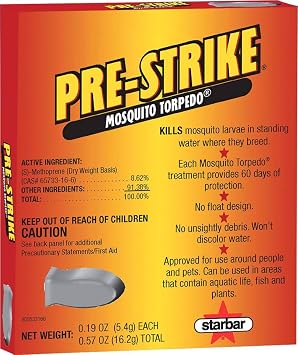
S-methoprene is an insect growth regulator used in slow-release larvicide products such as floating mosquito torpedoes placed in standing water. It is not a personal repellent and is not applied to skin. Rather than killing larvae outright, it mimics an insect juvenile hormone and blocks the larva from completing metamorphosis, so treated larvae never emerge as biting adults. It is EPA-registered and has low toxicity to people, pets, birds, and fish, though it is somewhat less target-specific than Bti because juvenile-hormone signaling is shared across insects and some other aquatic invertebrates.
How it works
S-methoprene is a juvenile hormone analog. Normal metamorphosis requires juvenile hormone to fall at the right time so a larva can pupate and emerge as an adult. S-methoprene keeps a juvenile-hormone-like signal present, which disrupts the molt from larva or pupa to adult. The insect is arrested in development and dies before it becomes a flying, biting adult, so wrigglers may still be visible in treated water for a time even though they cannot mature. Because it acts on development rather than on the nervous system, it does not knock down or repel adult mosquitoes.
Safety around dogs & cats
Methoprene has low toxicity to dogs, cats, and birds and is used at low doses in slow-release water products, so a pet drinking from treated standing water is not exposed to a meaningful hazard when the product is used as directed. It is also used in some pet flea products under veterinary registration, which reflects its low mammalian toxicity. Store it out of a pet's reach and do not let an animal chew a torpedo. It is a water treatment, never something to apply to an animal.
High confidence. Ratings from ASPCA Animal Poison Control, the Pet Poison Helpline, and published veterinary toxicology. This is general information, not veterinary advice. If your pet is exposed, call your vet or the ASPCA Animal Poison Control Center at (888) 426-4435.
The evidence
S-methoprene is an insect growth regulator that stops mosquito larvae from maturing into biting adults. Field and laboratory studies plus EPA review show slow-release formulations suppress adult emergence for roughly 30 days per treatment, with efficacy varying by species and dose and a low-risk profile for people and most non-target species.
- Assessing Insect Growth Regulator Resistance Using Bioassays: A Systematic Review and Meta-Analysis of Methoprene and Pyriproxyfen Inhibition of Emergence in Three Vector Mosquito Species2025Meta AnalysisDefinitive evidence
Systematic review and meta-analysis of methoprene and pyriproxyfen emergence inhibition across vector mosquitoes.
- Larvicides (CDC Mosquito Control guidance)2024ReviewWell-supported evidence
CDC public-health guidance on larvicides.
- Environmental safety review of methoprene and bacterially-derived pesticides commonly used for sustained mosquito control2017ReviewDefinitive evidence
Peer-reviewed non-target safety review of Bti and methoprene.
- Efficacy of methoprene for mosquito control in storm water catch basins2006Field TrialWell-supported evidence
Field trial of slow-release methoprene pellets in storm water catch basins.
- Effectiveness and residual activity comparison of granular formulations of insect growth regulators pyriproxyfen and s-methoprene against Florida mosquitoes2002LabWell-supported evidence
Laboratory and outdoor-tub comparison of s-methoprene and pyriproxyfen residual activity.
- Methoprene R.E.D. Fact Sheet1991ReviewDefinitive evidence
EPA regulatory review of methoprene as a mosquito larvicide and insect growth regulator.
Products using it

Regulatory notes
EPA-registered insect growth regulator (methoprene / S-methoprene). Registered for mosquito larval control in standing water and container products (for example the Pre-Strike Mosquito Torpedo, EPA Reg. No. 2724-499). It is not a 25(b) minimum-risk substance.
Safety notes
Not skin-applied, so dermal routes are not the relevant exposure. The EPA characterizes methoprene as low in toxicity to mammals and birds, and it degrades in sunlight and water. The main non-target caution is that, as a growth regulator, it can affect the development of some non-target aquatic invertebrates (notably certain crustaceans) at higher exposures, so it is less selective than Bti; follow label rates and treated-water guidance.