Study summary
Efficacy of unregulated minimum risk tick repellent products evaluated with Ixodes scapularis nymphs in a human skin bioassay
Burtis JC, Ford SL, Parise CM, Eisen RJ, Eisen L (CDC)
Read the original paper- Study type
- Lab
- Year
- 2024
- Species tested
- Ixodes scapularis nymphs
- Published in
- Parasites & Vectors
- Evidence strength
- Well-supported evidence
How it was tested
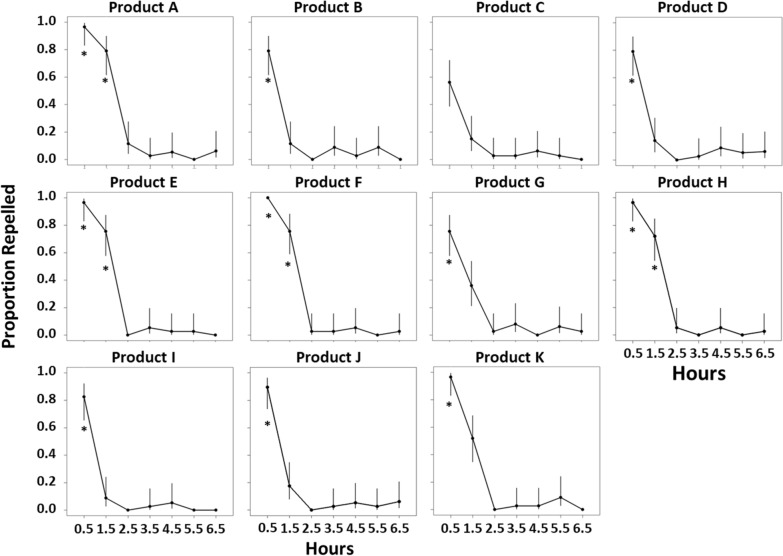
A finger bioassay applied each product to a treated fingertip, let it dry, then gave tick nymphs 80 seconds to cross onto the skin, repeated at seven time points out to 6.5 hours with thousands of nymphs.
Summary
This study filled the exact gap the CDC review flagged: it measured, on human skin, how well eleven unregulated botanical tick repellents keep blacklegged-tick nymphs off, against DEET, across 6.5 hours.
Key findings
The botanicals started decently and collapsed fast. As a group they repelled 86% of nymphs at 30 minutes but only 40% at 90 minutes and around 3% from 2.5 hours on, statistically no better than a plain ethanol control. The 25% DEET controls held 97 to 100% at every time point. Only four of the eleven exempt products still matched DEET at 90 minutes. Tellingly, neither the label claims nor the listed active ingredients predicted how long a product lasted.
Limitations
A single human subject, so no person-to-person skin variation, a short-crawl finger assay, and missing lot numbers and expiration dates on several products.