Luna Naturals
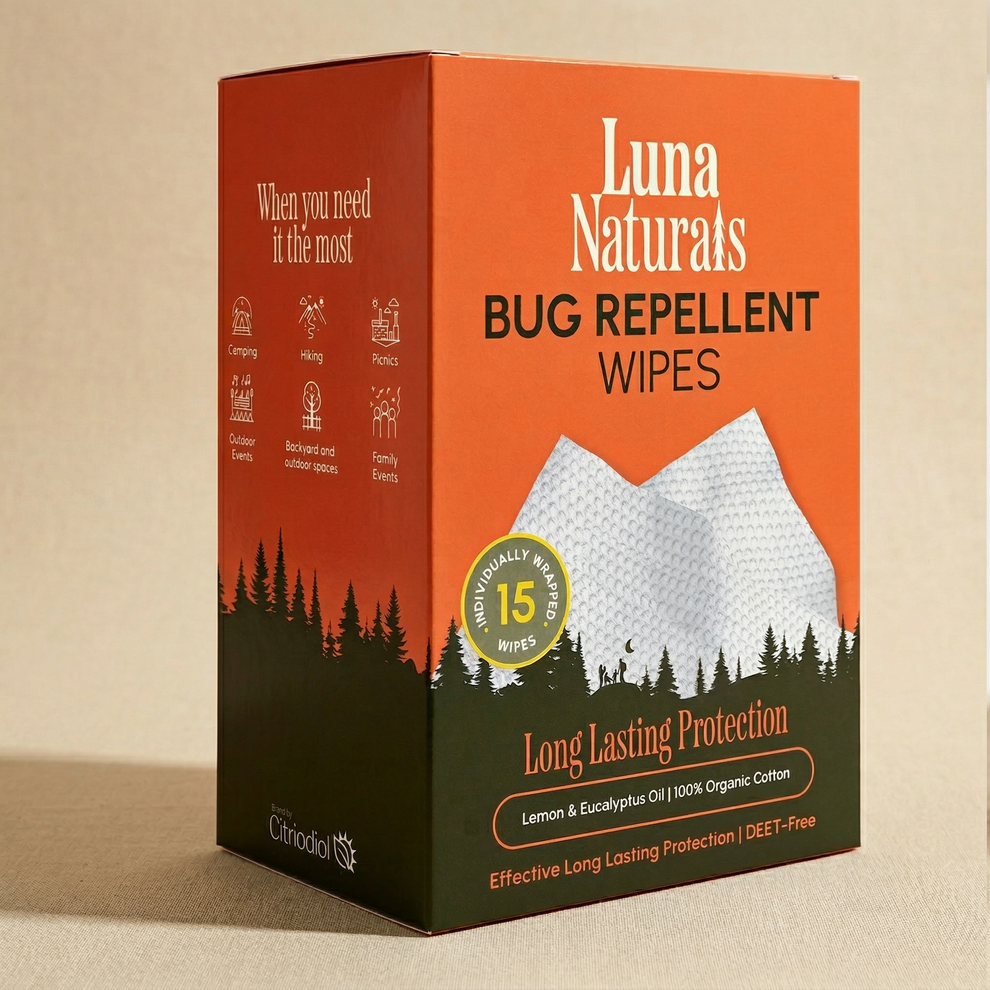
Luna Naturals Bug Repellent Wipes (Lemon Eucalyptus Oil)
Wipe · Not EPA-registered. Oil of lemon eucalyptus is not on EPA's 25(b) minimum-risk list, so a wipe making mosquito and tick claims on it needs registration rather than the exemption; no registration number is published and the ingredient list gives no concentration
Retailer links may earn us a commission. Scores are never affected.
Cons
- Active ingredient concentrations are not disclosed
- Sold without EPA registration despite actives that do not all qualify for the minimum-risk exemption
- Contains actives with notable skin-sensitization or irritation risk
- Not recommended for children under 3
The full review
Individually wrapped repellent wipes, and the one product in this range where oil of lemon eucalyptus is confirmed present: a retailer publishes the full ingredient list and it appears second, right after water. That is a genuine point in the wipes' favour, because oil of lemon eucalyptus is the only plant-derived active the CDC puts alongside DEET and picaridin. The catch is that the list is written as a cosmetic ingredient declaration rather than a repellent panel, so it names everything in order but attaches a percentage to nothing, and with oil of lemon eucalyptus the concentration is the whole story: registered products use around 30 percent to reach their published protection times, and a trace used for scent behaves nothing like that. There is a regulatory wrinkle too. Oil of lemon eucalyptus is not on EPA's minimum-risk list, so a wipe making mosquito and tick claims on the strength of it cannot ride the exemption the brand's citronella products can, and needs registration instead. The list also includes benzethonium chloride, a preservative that is not what anyone expects to find in a product sold as plant powered. A wipe is a genuinely good format for the format's own sake, easy to apply evenly and to pack; the uncertainty is entirely about dose and paperwork.
Scorecard
Expand any pillar to see exactly why it scored what it did.
Effectiveness45%10Mosquitoes: protection cannot be modeled because the active concentration is undisclosed. Ticks: protection cannot be modeled because the active concentration is undisclosed. Protection times are modeled from the actives, concentration, and format (see methodology). Scored on a saturating curve (each added hour counts less than the last), 65% mosquito / 35% tick, with lower confidence.
Mosquitoes: protection cannot be modeled because the active concentration is undisclosed. Ticks: protection cannot be modeled because the active concentration is undisclosed. Protection times are modeled from the actives, concentration, and format (see methodology). Scored on a saturating curve (each added hour counts less than the last), 65% mosquito / 35% tick, with lower confidence.
Evidence & honest claims25%25Oil of Lemon Eucalyptus is well-supported by published evidence, weighted by how close its concentration is to the studied effective dose (base 43). Of 3 marketing claims audited: 0 strong, 0 moderate, 3 weak, 0 unsupported (-18).
Oil of Lemon Eucalyptus is well-supported by published evidence, weighted by how close its concentration is to the studied effective dose (base 43). Of 3 marketing claims audited: 0 strong, 0 moderate, 3 weak, 0 unsupported (-18).
Safety15%52From published dermal toxicology (EPA/CIR/IFRA), scaled by each active's concentration against its leave-on limit: high skin-sensitization risk from Lemongrass oil (−18); high irritation risk from Thyme oil (−12); not recommended for children under 3 (Oil of Lemon Eucalyptus) (−8); caution advised in pregnancy (−6); moderate aquatic toxicity (−4).
From published dermal toxicology (EPA/CIR/IFRA), scaled by each active's concentration against its leave-on limit: high skin-sensitization risk from Lemongrass oil (−18); high irritation risk from Thyme oil (−12); not recommended for children under 3 (Oil of Lemon Eucalyptus) (−8); caution advised in pregnancy (−6); moderate aquatic toxicity (−4).
Transparency15%45This product publishes an ingredient list (+20); discloses 0% of active concentrations (+0); discloses 0% of all ingredient concentrations (+0); the full formula including inerts is accounted for (+25).
This product publishes an ingredient list (+20); discloses 0% of active concentrations (+0); discloses 0% of all ingredient concentrations (+0); the full formula including inerts is accounted for (+25).
Every pillar is scored from published rules. Read how we score.
How long it protects
Complete protection ends when the first bite gets through; partial protection keeps reducing bites as repellency decays. EPA label times are verified; the rest are modeled from the actives, concentration, and format.
Mosquito estimate basis (low confidence)
No protection time estimated — this product's label doesn't disclose the active ingredient's concentration, and protection depends on both the ingredient and its strength.
Tick estimate basis (low confidence)
No protection time estimated — this product's label doesn't disclose the active ingredient's concentration, and protection depends on both the ingredient and its strength.
Ingredient disclosure
This product publishes an ingredient list (+20); discloses 0% of active concentrations (+0); discloses 0% of all ingredient concentrations (+0); the full formula including inerts is accounted for (+25).
Active ingredient concentrations are not published for this product.
- Oil of Lemon EucalyptusActive
Active repellent · concentration not disclosed
- Rosemary oilActive
Active repellent · concentration not disclosed
- Thyme oilActive
Active repellent · concentration not disclosed
- Lemongrass oilActive
Active repellent · concentration not disclosed
- Bergamot oil
Inert / fragrance · concentration not disclosed
Claims audit
What the marketing says, versus what the evidence supports.
“Infused with lemon eucalyptus oil for effective, long-lasting protection”
DurationWeakThis list uses the right phrase. Oil of lemon eucalyptus, in that order, names the refined roughly 65 percent PMD material that EPA registers and the CDC recommends, as against lemon eucalyptus oil, the raw essential oil that is mostly citronellal and has not passed efficacy testing. That makes the wipes the strongest thing in this range on paper. Two gaps remain. Infused is a scent word rather than a dose, and with this active the dose is the whole question, since registered products reach their published times at around 30 percent. And if it genuinely is the registered-tier material at working strength, the product would need an EPA registration number, which it does not have.
“DEET-free, plant-powered protection without harsh chemicals”
NaturalWeakDEET-free is accurate. Plant-powered without harsh chemicals sits awkwardly against the brand's own ingredient list, which includes benzethonium chloride, phenoxyethanol, polysorbate 20, propylene glycol and butylene glycol. Those are ordinary, well-understood cosmetic ingredients and their presence is not a safety problem, but a product that draws a line between plants and harsh chemicals invites a comparison its own label does not survive.
“Effective protection from mosquitoes and ticks”
EfficacyWeakOil of lemon eucalyptus has the best evidence of any plant-derived repellent against mosquitoes, so the mechanism here is real rather than wishful, and this is the strongest product in the brand's range on that basis. What is missing is the dose and any testing of this particular wipe. The tick half is weaker: oil of lemon eucalyptus is studied far less against ticks, and a wipe's coverage is harder to keep complete over the ankles and legs where ticks actually attach.
Safe around dogs & cats?
Worst case from this product’s active ingredients. Do not apply this or any human repellent to your pet.
Mainly from Thyme oil, Lemongrass oil, Oil of Lemon Eucalyptus, and others.
Mainly from Rosemary oil, Thyme oil, Lemongrass oil.
Not veterinary advice. Full guide to repellents around pets →