Debunk
Do repellent balls work?Do mosquito repellent balls and pouches work?
Scented balls and pouches promising 60 days of protection are all over Amazon and social media. Here is why the format cannot work, and why the glowing posts about them are usually paid.
Updated July 28, 2026 · Reviewed against our scoring methodology
They show up as little mesh pouches or beige balls in an eight-pack, promising to keep mosquitoes away for two months with nothing but a plant-based scent. Set them on the patio, in the car, in a bedroom, and enjoy bite-free comfort. They are cheap, they smell nice, and right now they are everywhere, in Amazon search and all over social feeds. The oils inside, usually citronella and peppermint, are real repellents. The product still does not work, and the wave of positive posts about it is largely bought. Here is the whole picture.
The short version
A passive scented ball or pouch
Does not work
A repellent has to hold a vapor barrier right at your skin. A ball on a table cannot fill the open air around you with enough to stop bites, and there is no field evidence these reduce biting.
"Lasts 60 days" and "covers 120 sq ft"
Not achievable
The oils are volatile and evaporate fast, strongest for a day or two then fading within days. A static scent cannot treat 120 sq ft of moving air.
"Natural, safe for kids and pets"
Not for cats
Concentrated citronella and peppermint oils are both rated high-toxicity to cats, which cannot clear the terpenes. The blanket pet-safe badge is wrong.
The glowing reviews and videos
Often paid
Many are Amazon Creator Connections posts: the brand pays a 15 to 25 percent commission to whoever promotes it, and scripts the claims they make.
Why a scented ball cannot protect you
The oils are not the problem. The format is. A repellent works by keeping a thin cloud of vapor right against your skin, and that cloud only reaches a few centimeters. It is the same reason repellent wristbands fail: a source sitting away from your body leaves the rest of you exposed. A ball on a side table is even further away than a band on your wrist. Outdoors, any breeze scatters what little vapor it gives off. There is no controlled field study showing scented balls or pouches reduce how much you get bitten, and independent testing of essential-oil beads finds the scent peaks in the first day or two and mostly fades within three to five days.
The label math works against them
Look closely at one of these packs and the promise falls apart on its own terms. A typical ball lists something like 45 percent citronella oil and 24 percent peppermint oil, which is roughly 69 percent volatile oil in a ball that is only about 31 percent binder. That is the opposite of a slow-release design. The more volatile oil you pack in, the faster it flashes off, so a load that high cannot meter itself out over the 60 days, or the two to three months, printed on the bag. High concentration means it fades faster, not longer.
Not actually pet safe
These are marketed as safe for kids and pets, but both main oils are a real concern for cats. The ASPCA lists peppermint oil as toxic to dogs and cats, and concentrated citronella oil is in the same category. Cats clear these terpenes poorly, so a cat that chews or grooms a ball can drool, vomit, or go wobbly. If you have a cat, skip these or keep them completely out of reach.
Why your feed is suddenly full of them: the posts are paid
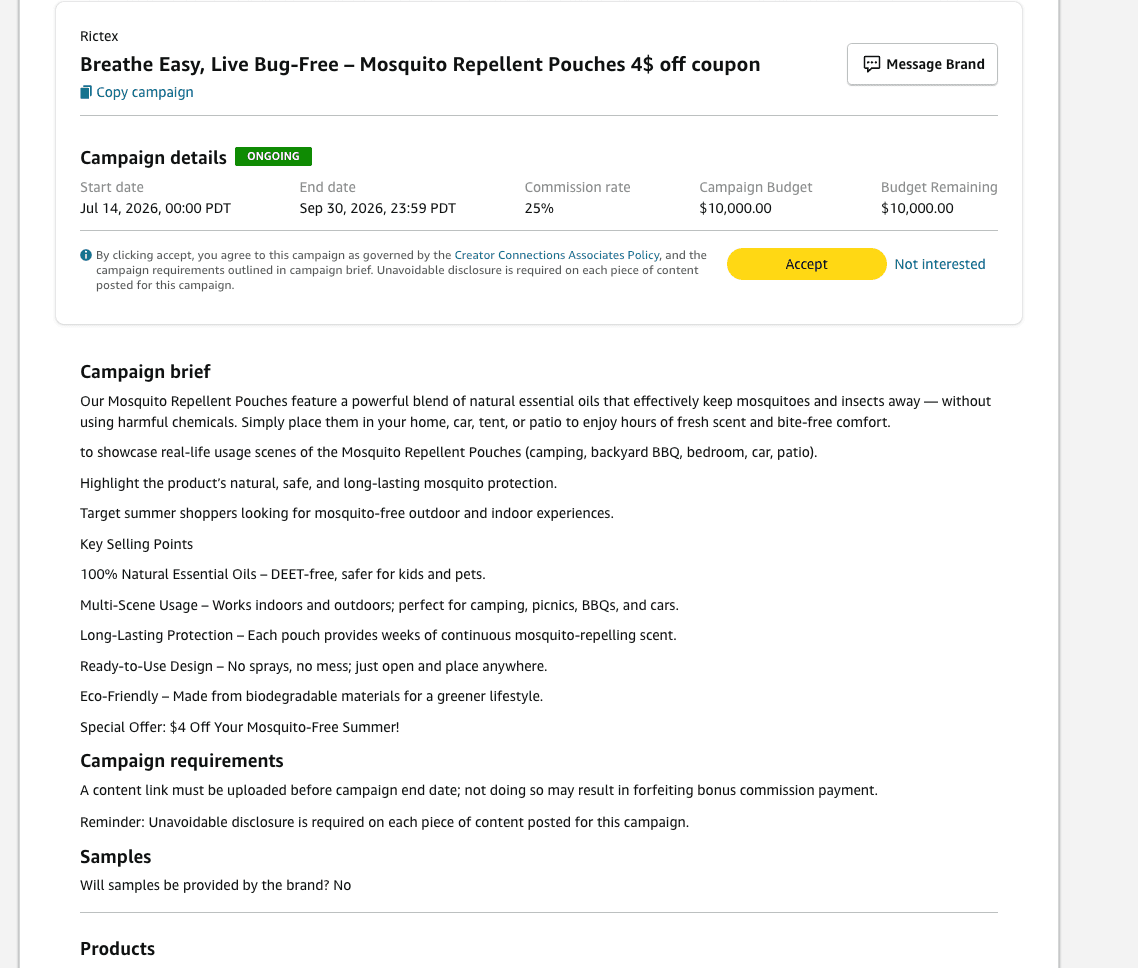
If it feels like every mosquito-season creator discovered the same little pouch at once, that is because they were paid to. Amazon runs a program called Creator Connections that lets a brand offer creators a commission to post content promoting a product, and these ball and pouch sellers are working it hard. One brand, Rictex, is running an ongoing campaign that pays a 25 percent commission out of a 10,000 dollar budget, and the brief tells creators in plain words to highlight the product's natural, safe, and long-lasting mosquito protection, listing selling points like each pouch provides weeks of continuous mosquito-repelling scent. Another, Scarilpest, is running several campaigns at a 15 percent commission. The brand does not even send a sample to test; it just pays for the promotion.
That is the shameful part. These sellers are not earning genuine word of mouth. They are buying the appearance of it, scripting the exact efficacy claims their product cannot back up, and paying a cut of every sale to whoever repeats them. The required disclosure is usually buried, so a shopper scrolling reviews and videos sees a wall of enthusiasm that was purchased, not earned. It is legal, and it is how a product that does not work can still look beloved.
The offers behind the buzz

The same product, a dozen names
A handful of the near-identical ball and pouch listings, each sold under a different random-letter brand:
How to spot one of these listings
A random-letter brand name
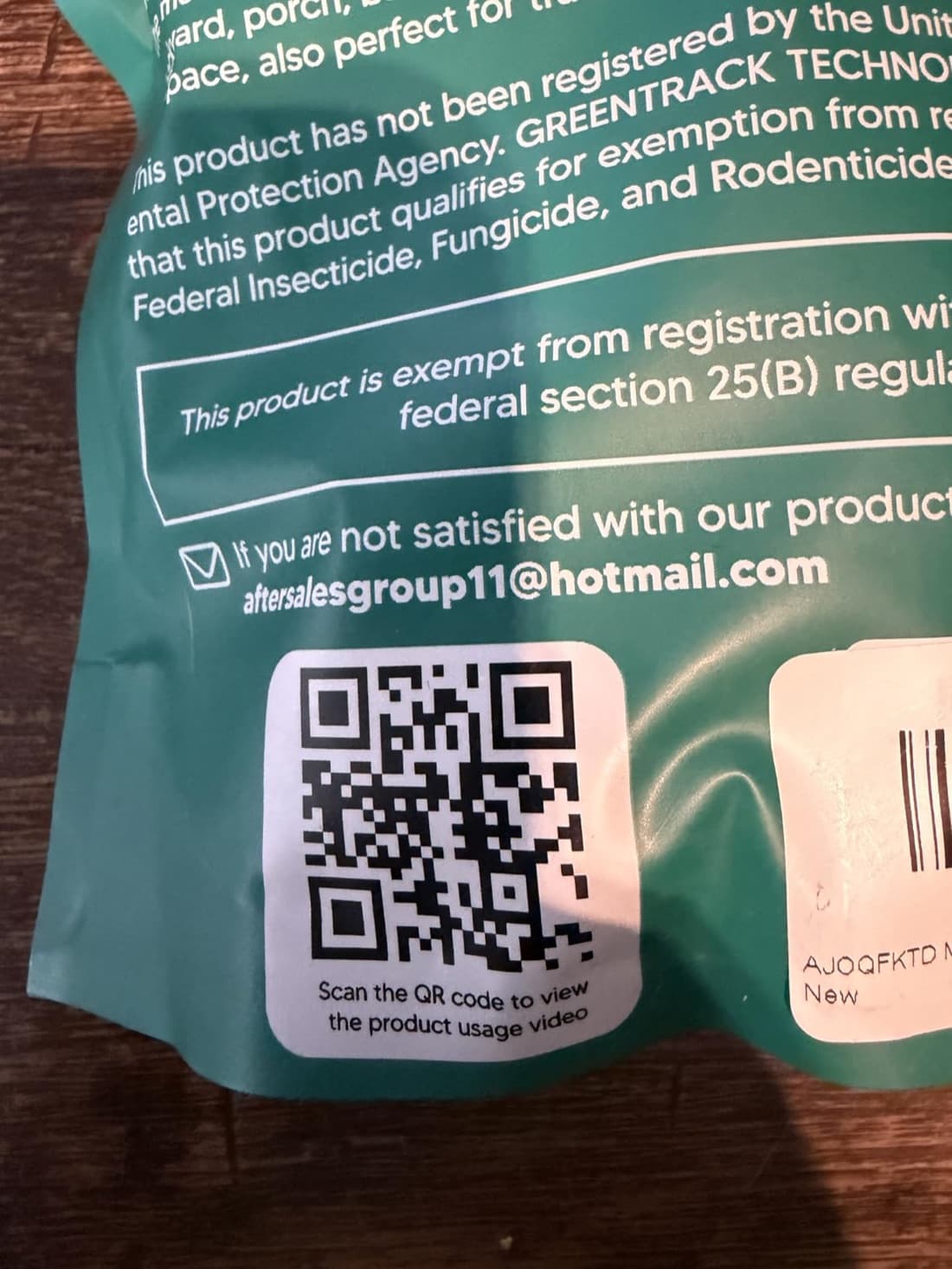
AJOQFKTD, SCFKAOF, Kopplvn. A real company does not name itself like a captcha. It is a throwaway Amazon storefront that can vanish and reappear under a new name.
A keyword-stuffed title
"Outdoor Patio, for Room, Indoor, for Yard, Covers 120 Sq Ft, 60 Days Protection" is written to win search results, not to describe an honest product.
No EPA registration, just a self-certified exemption
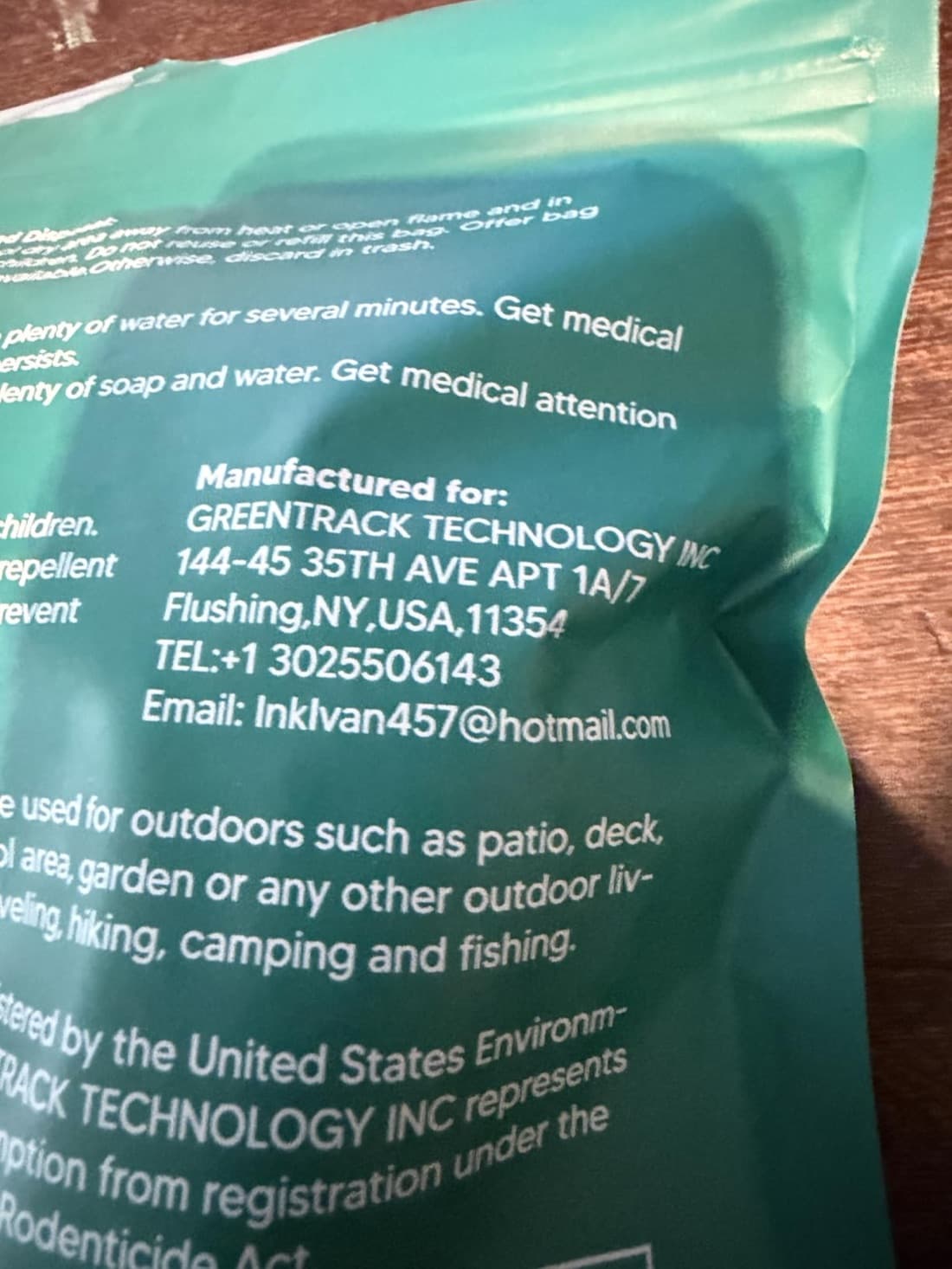
The bag says the seller "represents that this product qualifies" for the FIFRA 25(b) exemption. That is the company vouching for its own claims. No agency reviewed whether any of it is true.
A shell contact on the back
"Manufactured for" a company at a residential apartment, reachable only through a Hotmail address and a phone number in the wrong state. If it fails or harms a pet, there is no accountable manufacturer behind it.
The version we score, and why
We score one of these directly, with the evidence. It carries an honest failing score.

What actually works, and what we would buy
The same money, spent on tools with real field evidence: a repellent for your skin, a spatial device for the patio, and a Bti dunk for the standing water that breeds them.

Natrapel
Natrapel Picaridin Tick & Insect Repellent Eco-Spray
Picaridin 20%
Complete protection

Thermacell
Thermacell EX90 Rechargeable Mosquito Repeller
Metofluthrin 5.5%
Coverage & effectiveness

Summit
Summit Mosquito Dunks
Bti (Bacillus thuringiensis israelensis)
Larval control
Common questions
- Do mosquito repellent balls actually work?
- No. A passive scented ball or pouch cannot put enough repellent vapor into the open air around you to stop bites, the way a repellent on your skin does. There is no controlled field evidence that these reduce biting, and the essential-oil scent they rely on fades within a few days rather than the 60 advertised.
- Why are there so many positive reviews and videos?
- Many are paid. These brands run Amazon Creator Connections campaigns that pay creators a 15 to 25 percent commission to promote the product, and the campaign briefs script the claims, telling creators to emphasize natural, long-lasting protection. The enthusiasm is bought, and the required disclosure is usually easy to miss.
- Are mosquito repellent balls safe for pets?
- Not for cats. The citronella and peppermint oils are both rated high-toxicity to cats, which metabolize the terpenes poorly, and the ASPCA lists peppermint oil as toxic to dogs and cats. Despite the pet-safe badge, keep them away from cats especially, and from dogs and kids who might chew them.
- Is citronella a useless repellent, then?
- No, and that is the trap. Citronella and peppermint do repel mosquitoes for a short time when applied to skin. The problem is the format: a ball or pouch sitting nearby cannot create a protective zone, so real oils get wasted in a design that cannot deliver them.
- What actually works for mosquitoes instead?
- For a patio, a fan plus a Thermacell-type spatial device. For breeding water, a Bti dunk. On your skin, an EPA-registered repellent such as DEET, picaridin, IR3535, or oil of lemon eucalyptus. All have real evidence behind them, unlike the balls.