Study summary
Repellent efficacy of 20 essential oils on Aedes aegypti mosquitoes and Ixodes scapularis ticks in contact-repellency assays
Luker HA, Salas KR, Esmaeili D, Holguin FO, Bendzus-Mendoza H, Hansen IA
Read the original paper- Study type
- Lab
- Year
- 2023
- Species tested
- Aedes aegypti; Ixodes scapularis
- Published in
- Scientific Reports 13:1705
- Evidence strength
- Well-supported evidence
How it was tested
Contact-repellency assays of 20 essential oils at 10% v/v against both mosquitoes and blacklegged ticks, with time-course measurements of repellency decay.
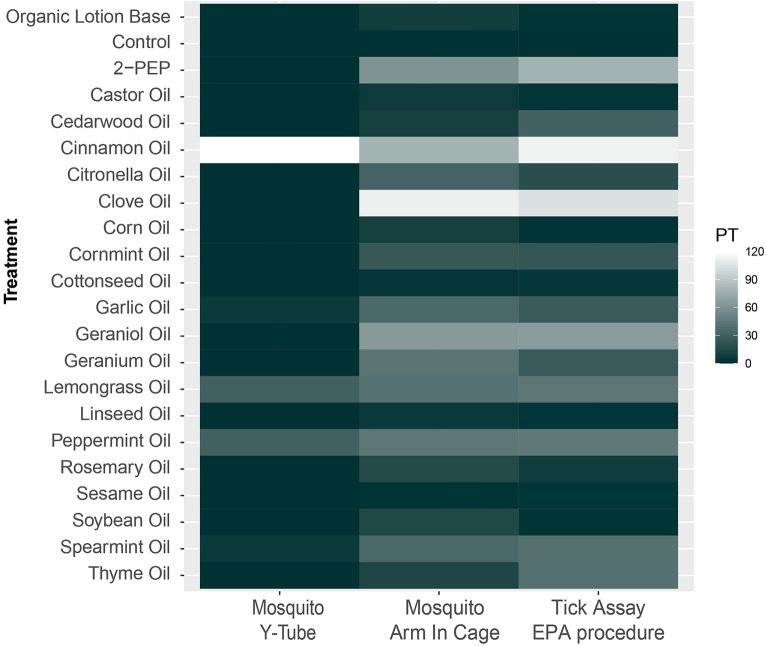
Summary
A New Mexico State University lab put 20 minimum-risk repellent ingredients through the same test at the same 10% strength, so the oils could be compared head to head instead of across studies that each used different doses and methods. The point was a like-for-like ranking of how long each one keeps Aedes aegypti mosquitoes and blacklegged ticks off skin.
Key findings
The authors sort the oils into tiers rather than publish an exact time for each. Four ingredients cleared an hour of complete protection against both pests: clove oil, cinnamon oil, geraniol, and 2-phenylethyl propionate. A middle group protected against mosquitoes for more than 30 minutes but did nothing against ticks: peppermint, geranium, lemongrass, garlic, spearmint, and citronella. Thyme oil was the exception, giving 55 minutes against ticks, the only exact figure the authors report, while failing against mosquitoes. The largest group, including rosemary, cedarwood, castor, corn, cottonseed, linseed, sesame, and soybean oil, was statistically no better than the plain lotion control at roughly two minutes. For scale, 10% DEET was still protecting at six hours when the experiment was stopped, so no botanical came close.
Limitations
Every oil was tested at a single 10% concentration in one lotion base, so a weak result can reflect that formulation rather than the oil's ceiling, and essential-oil composition varies by brand, batch, and growing conditions. These were laboratory contact assays with small samples, not field trials, so they do not capture sweat, heat, or reapplication.