Study summary
Evaluation of standard field and laboratory methods to compare protection times of the topical repellents PMD and DEET
Colucci B, Müller P
Read the original paper- Study type
- Field Trial
- Year
- 2018
- Species tested
- Aedes aegypti
- Published in
- Scientific Reports 8:12578
- Evidence strength
- Well-supported evidence
How it was tested
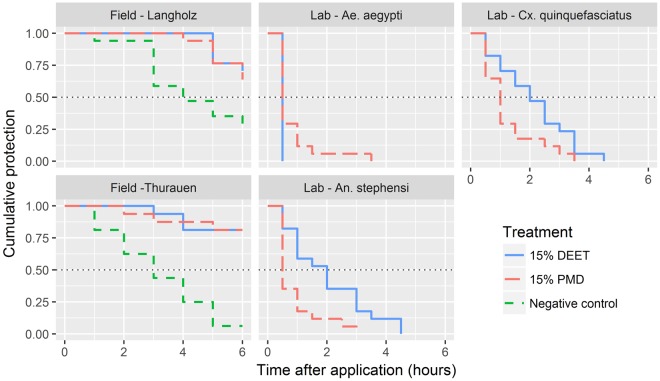
Compared arm-in-cage laboratory protocol against semi-field protection-time measurements for 15% PMD and 15% DEET, tracking repellency hourly over six hours.
Summary
An open-access study asking a methodological question: how well do laboratory arm-in-cage tests predict real-world field protection? It tested identical 15% PMD and 15% DEET solutions on the same volunteers in both settings.
Key findings
The two settings disagreed sharply. In the field, neither repellent's median protection had failed by the 6-hour endpoint, so 15% PMD and 15% DEET were effectively equal at 6 hours or more. In the lab, DEET looked clearly better, with median protection of about 2 hours against Anopheles and Culex versus roughly 30 minutes to 1 hour for PMD. The lesson is that the standard lab test underestimated real field protection and exaggerated DEET's edge over PMD.
Limitations
An unusually dry summer produced low field biting rates, different mosquito species were used in field versus lab, and the sample was small at 18 volunteers.