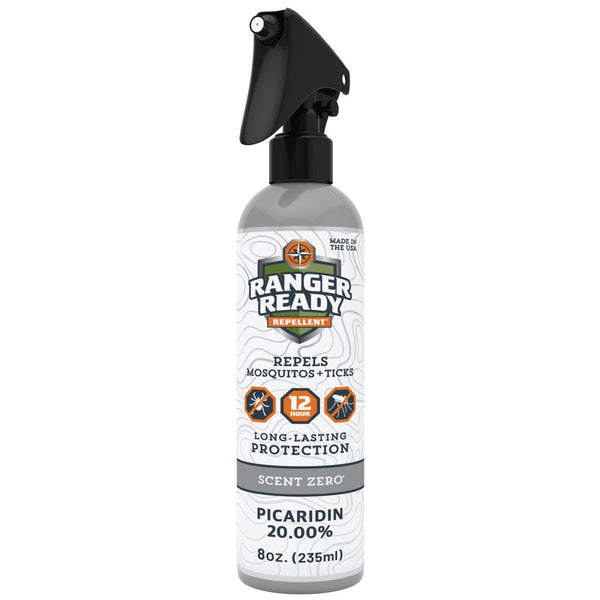
Ranger Ready
Ranger Ready Picaridin Insect Repellent Spray
Spray · EPA-registered
Retailer links may earn us a commission. Scores are never affected.
Pros
- Excellent all-day defense, 8 to 10 hours on mosquitoes and 8 to 10 on ticks from 20% picaridin.
- Picaridin's light feel plus scent options, and it won't harm gear or plastics.
Cons
No significant downsides for its role.
The full review
At 20% picaridin this quick-dry pump spray earns a top-tier recommended in the maximum protection category, with effectively nothing dragging it down. Effectiveness is excellent for a DEET-free formula, with modeled complete protection of 8 to 10 hours against mosquitoes and a genuine 8 to 10 hours against ticks, all without harming clothing or gear. Picaridin's evidence is about as definitive as repellent science gets, 5 of 6 audited claims rate strong, and the skin safety reads clean. The full formula including inerts is accounted for, so transparency is strong too. The label's up-to-12-hours figure measures reduced biting rather than bite-free time, so our window reads shorter by design, not contradiction.
Scorecard
Expand any pillar to see exactly why it scored what it did.
Effectiveness45%100Mosquitoes: 8–10 h of complete protection. Ticks: 8–10 h of complete protection. Protection times are modeled from the actives, concentration, and format (see methodology). Scored on a saturating curve (each added hour counts less than the last), 65% mosquito / 35% tick, with reasonable confidence.
Mosquitoes: 8–10 h of complete protection. Ticks: 8–10 h of complete protection. Protection times are modeled from the actives, concentration, and format (see methodology). Scored on a saturating curve (each added hour counts less than the last), 65% mosquito / 35% tick, with reasonable confidence.
Evidence & honest claims25%97Picaridin is backed by definitive published evidence, weighted by how close its concentration is to the studied effective dose (base 85). Of 6 marketing claims audited: 5 strong, 1 moderate, 0 weak, 0 unsupported (+12).
Picaridin is backed by definitive published evidence, weighted by how close its concentration is to the studied effective dose (base 85). Of 6 marketing claims audited: 5 strong, 1 moderate, 0 weak, 0 unsupported (+12).
Safety15%96From published dermal toxicology (EPA/CIR/IFRA), scaled by each active's concentration against its leave-on limit: no notable sensitization risk; low irritation; moderate aquatic toxicity (−4).
From published dermal toxicology (EPA/CIR/IFRA), scaled by each active's concentration against its leave-on limit: no notable sensitization risk; low irritation; moderate aquatic toxicity (−4).
Transparency15%88This product publishes an ingredient list (+20); discloses 100% of active concentrations (+40); discloses 20% of all ingredient concentrations (+3); the full formula including inerts is accounted for (+25).
This product publishes an ingredient list (+20); discloses 100% of active concentrations (+40); discloses 20% of all ingredient concentrations (+3); the full formula including inerts is accounted for (+25).
Every pillar is scored from published rules. Read how we score.
How long it protects
Complete protection ends when the first bite gets through; partial protection keeps reducing bites as repellency decays. EPA label times are verified; the rest are modeled from the actives, concentration, and format.
Mosquito estimate basis (moderate confidence)
Estimated complete protection time from active ingredient + concentration; the source research used a spray-style formulation, matching this spray (no format adjustment). Partial protection (reduced but real bite suppression) is modeled to extend to ~18 h as repellency decays.
Tick estimate basis (moderate confidence)
Estimated complete protection time from active ingredient + concentration; the source research used a spray-style formulation, matching this spray (no format adjustment). Partial protection (reduced but real bite suppression) is modeled to extend to ~18 h as repellency decays. Buchel 2015: 10% picaridin tick CPT ~5 h (I. scapularis) to 8 h (I. ricinus), equal to or better than 20% DEET. Carroll 2010: 20% kept ticks off through the full 12 h test against the lone star tick; we cap at a defensible ~10 h.
Ingredient disclosure
This product publishes an ingredient list (+20); discloses 100% of active concentrations (+40); discloses 20% of all ingredient concentrations (+3); the full formula including inerts is accounted for (+25).
- PicaridinActive
Active repellent · 20%
- Propylene glycol
Inert · concentration not disclosed
- Water
Inert / Carrier · concentration not disclosed
- Fragrance
Inert (scented variants; Scent Zero is fragrance-free) · concentration not disclosed
- Alcohol
Inert / Carrier · concentration not disclosed
Claims audit
What the marketing says, versus what the evidence supports.
“Contains no DEET”
Deet FreeStrongWell supported by published evidence
“Non-greasy, quick-dry formula won't damage clothing or gear”
OtherModerateConsistent with picaridin's known material compatibility (unlike DEET, it does not damage plastics/synthetics).
“8-hour protection from gnats, flies, fleas, chiggers, and no-see-ums”
DurationStrongFrom the EPA-accepted label ('Repels biting flies, stable flies, black flies, gnats, chiggers, sand flies, and Scottish biting midges for up to 8 hours').
“Protection from mosquitoes that may transmit West Nile, Chikungunya, Dengue, and Zika, and ticks carrying Lyme disease”
EfficacyStrongPicaridin at 20% gives ~8–10 h complete mosquito and ~7–8 h complete tick protection, supporting the vector list.
“Picaridin 20%”
EfficacyStrongActive ingredient concentration confirmed on the EPA master label.
“12-hour protection from ticks and mosquitoes”
DurationStrongEPA label-approved protection time, confirmed in the EPA repellent search tool (12/12 hours).
Safe around dogs & cats?
Worst case from this product’s active ingredients. Do not apply this or any human repellent to your pet.
Not veterinary advice. Full guide to repellents around pets →