Avon
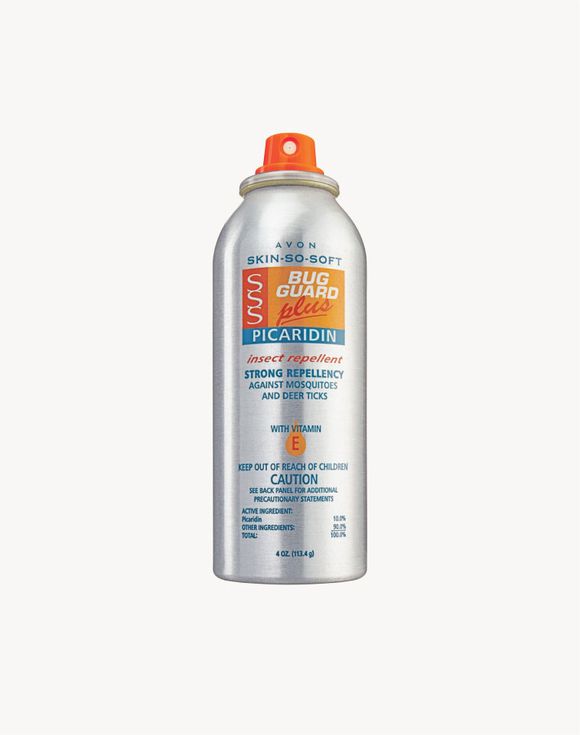
Skin So Soft Bug Guard Plus Picaridin Aerosol Spray
Spray · EPA-registered
Retailer links may earn us a commission. Scores are never affected.
Pros
- Excellent all-round protection, 5 to 7 hours on mosquitoes and 5 to 8 on ticks from 10% picaridin.
- Picaridin feels lighter and less greasy than DEET and won't damage plastics or gear.
Cons
- Aerosol delivery feels cold and wet on contact, with some overspray to breathe.
The full review
The aerosol twin of Avon's picaridin pump earns the same recommended rating. With 10% picaridin it leans on a definitive evidence base, a clean safety profile, and an unusually strong claim audit where 7 of 8 marketing claims rate strong. Complete protection comes in at 5 to 7 hours for mosquitoes and 5 to 8 for ticks, shorter than the label's reapply intervals because those track reduced biting rather than time to first bite. As with the pump, the lone soft spot is transparency, since the full formula is accounted for but only the active concentration is quantified. Picaridin feels lighter and less greasy than DEET and won't damage gear, though the aerosol lands cold and wet with some overspray to breathe.
Scorecard
Expand any pillar to see exactly why it scored what it did.
Effectiveness45%96Mosquitoes: 5–7 h of complete protection. Ticks: 5–8 h of complete protection. Protection times are modeled from the actives, concentration, and format (see methodology). Scored on a saturating curve (each added hour counts less than the last), 65% mosquito / 35% tick, with reasonable confidence.
Mosquitoes: 5–7 h of complete protection. Ticks: 5–8 h of complete protection. Protection times are modeled from the actives, concentration, and format (see methodology). Scored on a saturating curve (each added hour counts less than the last), 65% mosquito / 35% tick, with reasonable confidence.
Evidence & honest claims25%97Picaridin is backed by definitive published evidence, weighted by how close its concentration is to the studied effective dose (base 85). Of 8 marketing claims audited: 7 strong, 1 moderate, 0 weak, 0 unsupported (+12).
Picaridin is backed by definitive published evidence, weighted by how close its concentration is to the studied effective dose (base 85). Of 8 marketing claims audited: 7 strong, 1 moderate, 0 weak, 0 unsupported (+12).
Safety15%96From published dermal toxicology (EPA/CIR/IFRA), scaled by each active's concentration against its leave-on limit: no notable sensitization risk; low irritation; moderate aquatic toxicity (−4).
From published dermal toxicology (EPA/CIR/IFRA), scaled by each active's concentration against its leave-on limit: no notable sensitization risk; low irritation; moderate aquatic toxicity (−4).
Transparency15%87This product publishes an ingredient list (+20); discloses 100% of active concentrations (+40); discloses 11% of all ingredient concentrations (+2); the full formula including inerts is accounted for (+25).
This product publishes an ingredient list (+20); discloses 100% of active concentrations (+40); discloses 11% of all ingredient concentrations (+2); the full formula including inerts is accounted for (+25).
Every pillar is scored from published rules. Read how we score.
How long it protects
Complete protection ends when the first bite gets through; partial protection keeps reducing bites as repellency decays. EPA label times are verified; the rest are modeled from the actives, concentration, and format.
Mosquito estimate basis (moderate confidence)
Estimated complete protection time from active ingredient + concentration; the source research used a spray-style formulation, matching this spray (no format adjustment). Partial protection (reduced but real bite suppression) is modeled to extend to ~12 h as repellency decays.
Tick estimate basis (moderate confidence)
Estimated complete protection time from active ingredient + concentration; the source research used a spray-style formulation, matching this spray (no format adjustment). Partial protection (reduced but real bite suppression) is modeled to extend to ~14 h as repellency decays. Buchel 2015: 10% picaridin tick CPT ~5 h (I. scapularis) to 8 h (I. ricinus), equal to or better than 20% DEET. Carroll 2010: 20% kept ticks off through the full 12 h test against the lone star tick; we cap at a defensible ~10 h.
Ingredient disclosure
This product publishes an ingredient list (+20); discloses 100% of active concentrations (+40); discloses 11% of all ingredient concentrations (+2); the full formula including inerts is accounted for (+25).
- PicaridinActive
Active repellent · 10%
- Vitamin E
Inert · concentration not disclosed
- Isobutane
Inert / Propellant · concentration not disclosed
- Hexylene glycol
Inert · concentration not disclosed
- Water
Inert / Carrier · concentration not disclosed
- SD Alcohol 40-B
Inert / Carrier · concentration not disclosed
- Polyurethane copolymer
Inert · concentration not disclosed
- Propane
Inert / Propellant · concentration not disclosed
- Fragrance
Inert · concentration not disclosed
Claims audit
What the marketing says, versus what the evidence supports.
“Repels deer ticks (Lyme) up to 7 hours”
DurationStrongConsistent with our complete-protection estimate (~8 h).
“Repels black flies up to 3 hours”
EfficacyStrongaerosol label
“Dermatologist tested”
OtherModerateBrand testing claim; not independently verified.
“Repels deer ticks that may transmit Lyme disease”
EfficacyStrongEPA lists 7-hour tick protection for this registration.
“Repels a broad spectrum of biting insects (gnats, no-seeums, sand flies, biting midges, black flies)”
EfficacyStrongListed on Avon's product page with specific reapplication intervals (7 hours; black flies 3 hours).
“DEET-free and oil-free, with low odor and a light, clean feel”
Deet FreeStrongAccurate; picaridin is the active.
“Repels mosquitoes that may transmit West Nile virus (reapply after 6 hours)”
DurationStrongConsistent with our complete-protection estimate (~7 h).
“Picaridin 10%”
EfficacyStrongConfirmed by EPA registration data and Avon's published ingredient list.
Safe around dogs & cats?
Worst case from this product’s active ingredients. Do not apply this or any human repellent to your pet.
Not veterinary advice. Full guide to repellents around pets →