Study summary
Repellency of Essential Oils and Plant-Derived Compounds Against Aedes aegypti Mosquitoes
Lopez AD, Whyms S, Luker HA, Galvan CJ, Holguin FO, Hansen IA
Read the original paper- Study type
- Lab
- Year
- 2025
- Species tested
- Aedes aegypti
- Published in
- Insects 16(1):51
- Evidence strength
- Well-supported evidence
How it was tested
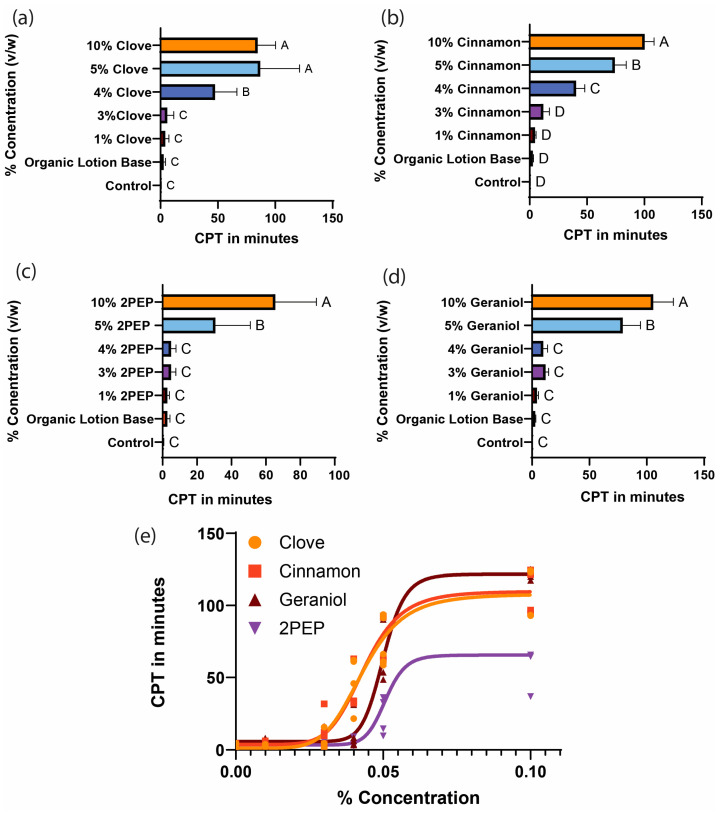
Using an arm-in-cage assay with compounds mixed into an organic lotion base, the team measured complete protection time (minutes to the first bite) for geraniol and five other plant compounds across 1, 3, 4, 5, and 10% concentrations against Aedes aegypti, with 6% DEET as the control.
Summary
This lab study mapped how geraniol's mosquito repellency changes with dose, following the same group's earlier finding that a handful of botanicals cleared an hour of protection at 10%. The question was practical: how much geraniol do you actually need, and does protection build gradually or switch on at a threshold?
Key findings
Geraniol has a threshold, not a gradual slope. Its dose-response curve was steeply sigmoidal, with a half-maximal effect at 5.0% and a very steep rise, and the authors report a 16-fold jump in protection time between 4% and 5%. Below about 4% geraniol does little; at 5 to 10% it cleared an hour of complete protection. For comparison, 10% clove oil protected for 111 minutes, the best botanical in the set, while 6% DEET lasted the full six hours the test ran. Mixing compounds did not beat the single actives. The shopper takeaway is blunt: with geraniol the label percentage matters enormously, and anything under about 5% is unlikely to do much.
Limitations
This is a single-lab cage assay, and essential-oil performance depends heavily on the carrier and on batch-to-batch variation in the oils. The exact minute values at each concentration appear only in the paper's figures, and evaporation and skin-absorption behavior were not separately measured.