Study summary
Evaluation of the efficacy of 20% IR3535 with a sustained-release formulation and 25% DEET against mosquitoes in a field setting in Ghana
Abudu M, Asafu-Adjaye A, Osei JHN, et al.
Read the original paper- Study type
- Field Trial
- Year
- 2025
- Species tested
- Wild mosquito populations (Ghana)
- Published in
- Parasites & Vectors 18:398
- Evidence strength
- Well-supported evidence
How it was tested
Field comparison of 20% sustained-release IR3535 against 25% DEET; reports percentage protective efficacy rather than a measured complete-protection time.
Summary
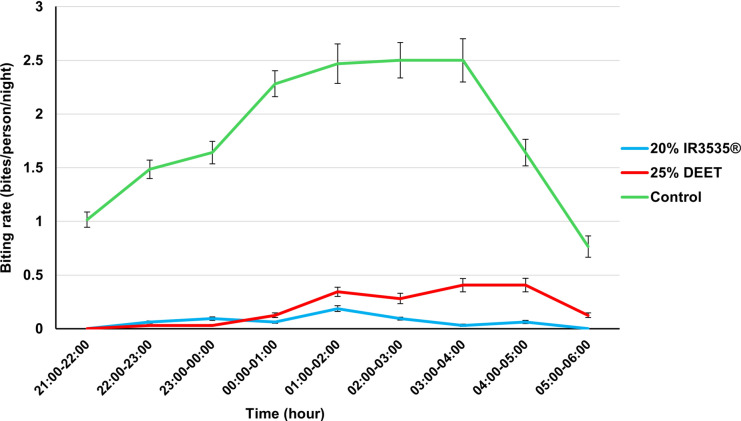
A 2025 field trial in two rural Ghanaian communities pitted a 20% IR3535 lotion built on a sustained-release technology against a 25% DEET lotion, tested on wild, mostly malaria-vector mosquitoes. Both slashed biting against a control, with IR3535 marginally ahead.
Key findings
Both repellents were highly effective. 20% IR3535 cut bites by 98% and 25% DEET by 95% against the control, a difference that was not statistically significant. Measured as the share of time protected, IR3535 held 91.9% and DEET 89.2%, and both kept protection above 80% for a full 9 hours. Mean bites per person per night ran 0.59 for IR3535 and 1.75 for DEET against 16.3 for the control. IR3535 was numerically best on every measure without separating statistically from DEET.
Limitations
A single wet-season window with eight collectors in two communities, and the endpoint was bites prevented rather than malaria cases; the authors call for community-wide trials to measure disease impact.