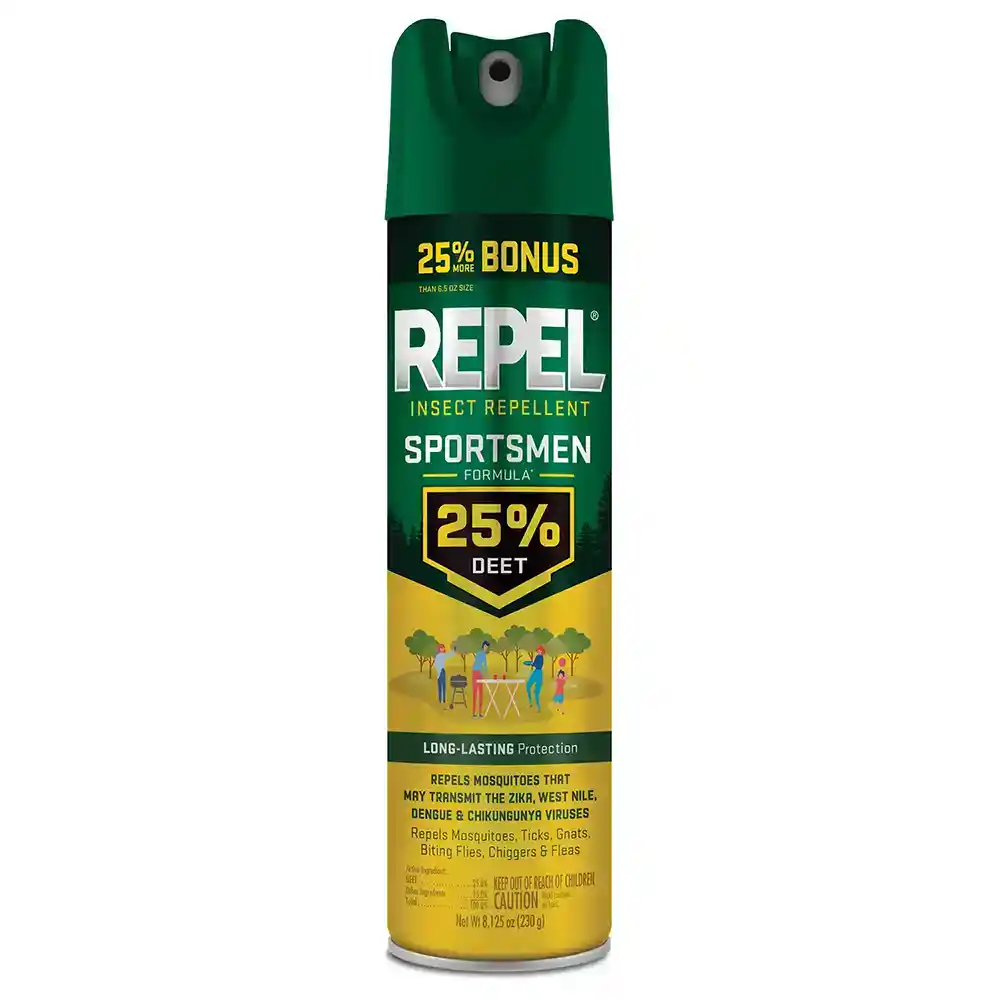
Repel
Insect Repellent Sportsmen Formula 25% DEET
Spray · EPA-registered
Retailer links may earn us a commission. Scores are never affected.
Pros
- A solid 25% DEET for a day outdoors, 5 to 6 hours of cover with everything disclosed.
Cons
- Standard DEET trade-offs: a tacky feel, and keep it off plastics and lenses.
The full review
Stepping up to 25% DEET pushes this sportsmen aerosol to a strong recommended, with the gain coming almost entirely from durability. Our model puts complete protection near 5 to 6 hours for mosquitoes and 4 to 6 hours for ticks, enough for a full day outdoors, while the evidence and safety pillars both sit near the top. All 5 audited claims check out, so the label's reputation holds. The brand's "up to 10 hours" figure measures reduced biting rather than bite-free time, which is why our complete-protection window reads shorter, and that is expected. The main drag is transparency, since the inert ingredients are never disclosed; otherwise expect the usual DEET trade-offs of a tacky feel and care around plastics.
Scorecard
Expand any pillar to see exactly why it scored what it did.
Effectiveness45%94Mosquitoes: 5–6 h of complete protection. Ticks: 4–6 h of complete protection. Protection times are modeled from the actives, concentration, and format (see methodology). Scored on a saturating curve (each added hour counts less than the last), 65% mosquito / 35% tick, with reasonable confidence.
Mosquitoes: 5–6 h of complete protection. Ticks: 4–6 h of complete protection. Protection times are modeled from the actives, concentration, and format (see methodology). Scored on a saturating curve (each added hour counts less than the last), 65% mosquito / 35% tick, with reasonable confidence.
Evidence & honest claims25%97DEET is backed by definitive published evidence, weighted by how close its concentration is to the studied effective dose (base 85). Of 5 marketing claims audited: 3 strong, 2 moderate, 0 weak, 0 unsupported (+12).
DEET is backed by definitive published evidence, weighted by how close its concentration is to the studied effective dose (base 85). Of 5 marketing claims audited: 3 strong, 2 moderate, 0 weak, 0 unsupported (+12).
Safety15%96From published dermal toxicology (EPA/CIR/IFRA), scaled by each active's concentration against its leave-on limit: no notable sensitization risk; low irritation; moderate aquatic toxicity (−4).
From published dermal toxicology (EPA/CIR/IFRA), scaled by each active's concentration against its leave-on limit: no notable sensitization risk; low irritation; moderate aquatic toxicity (−4).
Transparency15%75This product publishes an ingredient list (+20); discloses 100% of active concentrations (+40); discloses 100% of all ingredient concentrations (+15); inert ingredients are not fully accounted for (0).
This product publishes an ingredient list (+20); discloses 100% of active concentrations (+40); discloses 100% of all ingredient concentrations (+15); inert ingredients are not fully accounted for (0).
Every pillar is scored from published rules. Read how we score.
How long it protects
Complete protection ends when the first bite gets through; partial protection keeps reducing bites as repellency decays. EPA label times are verified; the rest are modeled from the actives, concentration, and format.
Mosquito estimate basis (moderate confidence)
Estimated complete protection time from active ingredient + concentration; the source research used a spray-style formulation, matching this spray (no format adjustment). Partial protection (reduced but real bite suppression) is modeled to extend to ~11 h as repellency decays.
Tick estimate basis (moderate confidence)
Estimated complete protection time from active ingredient + concentration; the source research used a spray-style formulation, matching this spray (no format adjustment). Partial protection (reduced but real bite suppression) is modeled to extend to ~11 h as repellency decays. Ticks only: estimated against Ixodes scapularis (the US Lyme vector). DEET is notably weaker against the lone star tick (Amblyomma americanum) and some dog-tick (Dermacentor) populations, and weaker on ticks than on mosquitoes. Anchors: Burtis 2024 (CDC), 25% DEET held >=97% skin repellency through 6.5 h; Buchel 2015, 20% median tick CPT ~4-4.5 h.
Ingredient disclosure
This product publishes an ingredient list (+20); discloses 100% of active concentrations (+40); discloses 100% of all ingredient concentrations (+15); inert ingredients are not fully accounted for (0).
Only active ingredients are disclosed. The full ingredient list (inerts/carriers) is not published, so this may not be the complete formula.
- DEETActive
Active repellent · 25%
Claims audit
What the marketing says, versus what the evidence supports.
“Non-greasy, won't stain, no unpleasant odor”
OtherModerateCosmetic/feel claims from the EPA-accepted label.
“Up to 10 hours of protection from mosquitoes”
DurationModerateWithin the partial-protection window: complete (bite-free) protection is ~6 h, with reduced protection persisting to ~11 h. The claimed 10 h is optimistic but plausible as partial protection.
“Repels mosquitoes that may transmit the Zika, West Nile, Dengue and Chikungunya viruses”
EfficacyStrongEPA-registered label claim; repellency does not guarantee disease prevention.
“Also repels ticks, gnats, biting flies, chiggers, fleas and no-see-ums”
EfficacyStrongEPA-registered pest spectrum for 25% DEET.
“DEET 25%”
EfficacyStrongActive ingredient concentration confirmed by EPA registration and product label.
Safe around dogs & cats?
Worst case from this product’s active ingredients. Do not apply this or any human repellent to your pet.
Mainly from DEET.
Mainly from DEET.
Not veterinary advice. Full guide to repellents around pets →
The label
Ingredients, warnings, and directions from the package label. Read it before you buy.
