Summary
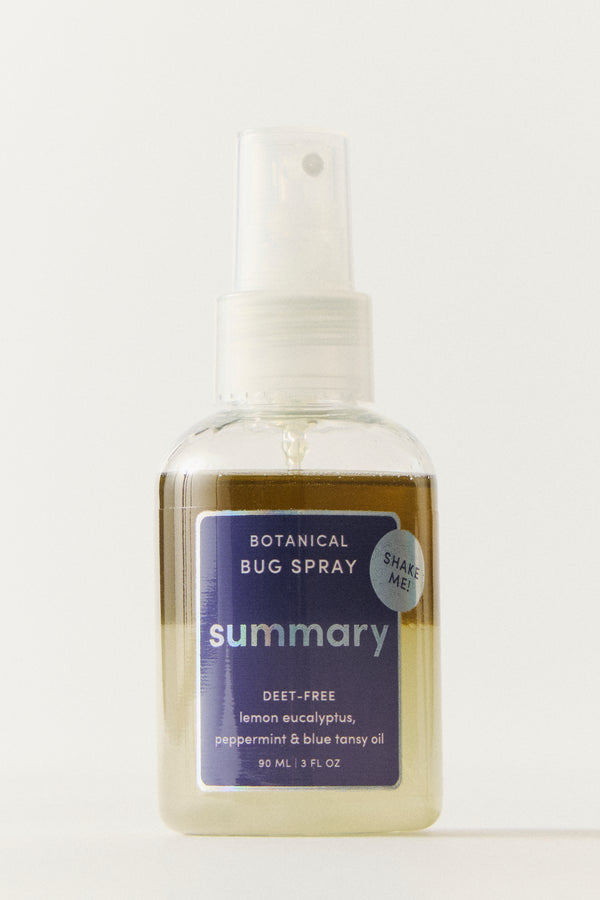
Summary Botanical Bug Spray
Spray · Not EPA-registered; label discloses active ingredient percentages and other ingredients in FIFRA 25(b) minimum-risk style, but the brand makes no explicit exemption claim
Retailer links may earn us a commission. Scores are never affected.
Pros
- A genuinely beautiful skincare-grade base: flaxseed, tamanu, andiroba, and blue tansy oils make it a treat to wear.
Cons
- Too dilute to repel, with actives well under a tenth of a percent and no proven protection.
- Even trace lemongrass adds a small sensitization risk.
The full review
This botanical spray lands in not-recommended territory for a structural reason: at 0.07% lemongrass and 0.02% peppermint, the actives are too dilute to demonstrate reliable protection, so the effectiveness pillar all but bottoms out and our model treats both mosquito and tick coverage as minimal or unproven. What it does well is be gentle and honest. Safety is excellent because those tiny concentrations keep sensitization and irritation risk low, the evidence is reasonable with 3 of 5 claims strong, and transparency is strong thanks to a full ingredient list with every active percentage disclosed. As a skin-friendly beauty product on a skincare-grade base of flaxseed, tamanu, and blue tansy oils it delivers, but as a repellent it offers no dependable barrier against bites.
Scorecard
Expand any pillar to see exactly why it scored what it did.
Effectiveness45%8Mosquitoes: minimal or unproven protection. Ticks: minimal or unproven protection. Protection times are modeled from the actives, concentration, and format (see methodology). Scored on a saturating curve (each added hour counts less than the last), 65% mosquito / 35% tick, with reasonable confidence.
Mosquitoes: minimal or unproven protection. Ticks: minimal or unproven protection. Protection times are modeled from the actives, concentration, and format (see methodology). Scored on a saturating curve (each added hour counts less than the last), 65% mosquito / 35% tick, with reasonable confidence.
Evidence & honest claims25%65Peppermint oil is well-supported by published evidence, weighted by how close its concentration is to the studied effective dose (base 56). Of 5 marketing claims audited: 3 strong, 1 moderate, 1 weak, 0 unsupported (+9).
Peppermint oil is well-supported by published evidence, weighted by how close its concentration is to the studied effective dose (base 56). Of 5 marketing claims audited: 3 strong, 1 moderate, 1 weak, 0 unsupported (+9).
Safety15%87From published dermal toxicology (EPA/CIR/IFRA), scaled by each active's concentration against its leave-on limit: high skin-sensitization risk from Lemongrass oil at 0.07% (−2); moderate irritation risk from Lemongrass oil at 0.07% (−1); caution advised in pregnancy (−6); moderate aquatic toxicity (−4).
From published dermal toxicology (EPA/CIR/IFRA), scaled by each active's concentration against its leave-on limit: high skin-sensitization risk from Lemongrass oil at 0.07% (−2); moderate irritation risk from Lemongrass oil at 0.07% (−1); caution advised in pregnancy (−6); moderate aquatic toxicity (−4).
Transparency15%86This product publishes an ingredient list (+20); discloses 100% of active concentrations (+40); discloses 10% of all ingredient concentrations (+1); the full formula including inerts is accounted for (+25).
This product publishes an ingredient list (+20); discloses 100% of active concentrations (+40); discloses 10% of all ingredient concentrations (+1); the full formula including inerts is accounted for (+25).
Every pillar is scored from published rules. Read how we score.
How long it protects
Complete protection ends when the first bite gets through; partial protection keeps reducing bites as repellency decays. EPA label times are verified; the rest are modeled from the actives, concentration, and format.
Mosquito estimate basis (low confidence)
Botanical actives show little to no reliable mosquito protection; reapply very frequently if used at all. No measured CPT below 10% for this active — estimated via sigmoid dose-response (×0.00 of Luker 2023 (10% lotion, CPT > 30 min)).
Tick estimate basis (low confidence)
Botanical actives show little to no reliable tick protection; reapply very frequently if used at all. On human-skin tick bioassays these oils protect for well under an hour and most show no significant protection versus an untreated control (Eisen 2024; Le Mauff 2024; Luker 2023).
Ingredient disclosure
This product publishes an ingredient list (+20); discloses 100% of active concentrations (+40); discloses 10% of all ingredient concentrations (+1); the full formula including inerts is accounted for (+25).
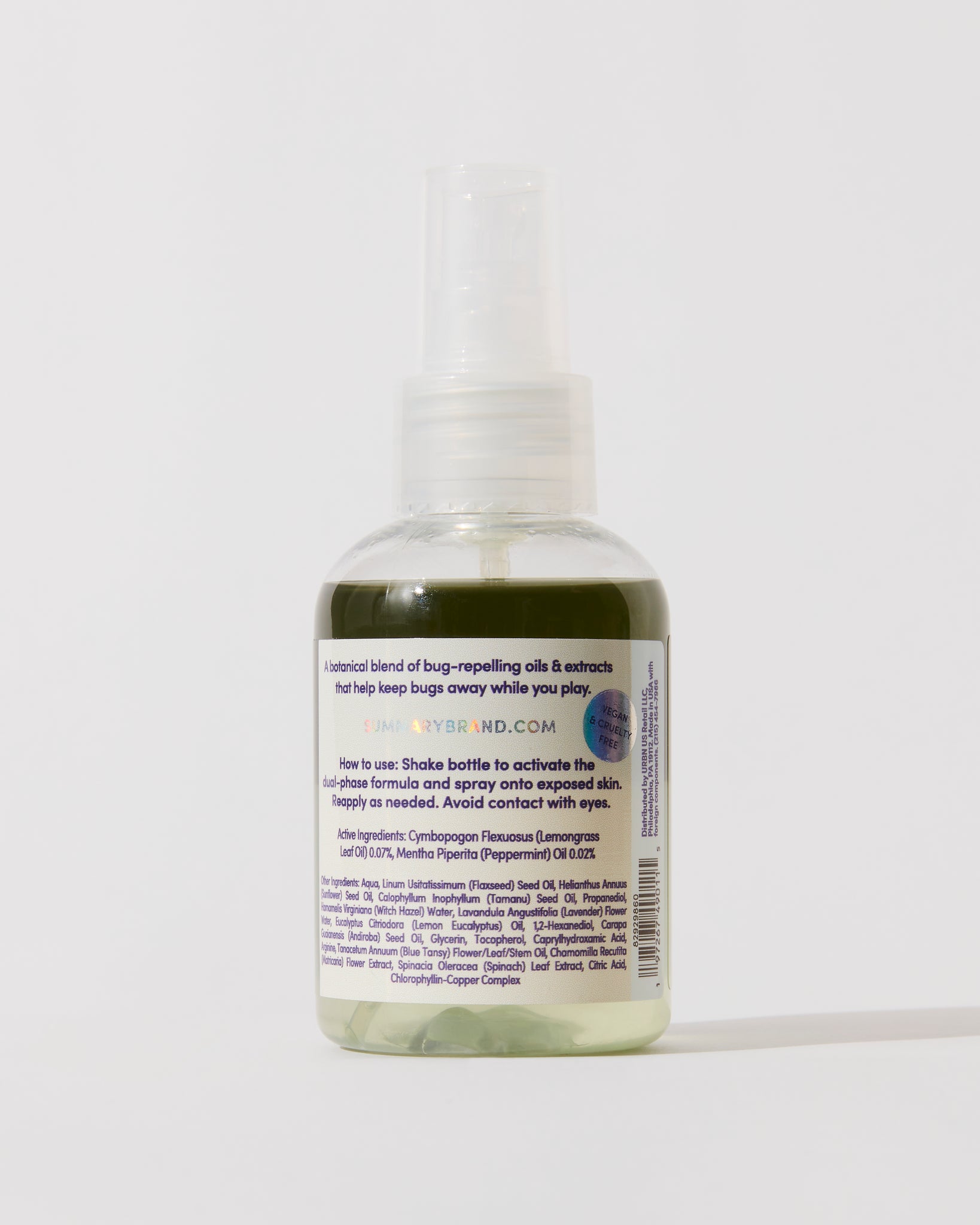
- Lemongrass oilActive
Active repellent · 0.07%
- Peppermint oilActive
Active repellent · 0.02%
- Oil of Lemon Eucalyptus
Inert (listed under other ingredients) · concentration not disclosed
- Water
Inert (carrier) · concentration not disclosed
- Flaxseed seed oil
Inert (carrier oil) · concentration not disclosed
- Sunflower (Helianthus annuus) Seed Oil
Inert (carrier oil) · concentration not disclosed
- Tamanu seed oil
Inert (skin conditioning) · concentration not disclosed
- Propanediol
Inert · concentration not disclosed
- Witch hazel water
Inert (skin soothing) · concentration not disclosed
- Lavender flower water
Inert (skin soothing) · concentration not disclosed
- 1,2-Hexanediol
Inert (preservative system) · concentration not disclosed
- Andiroba seed oil
Inert (botanical, marketed as bug-deterring) · concentration not disclosed
- Glycerin
Inert (humectant) · concentration not disclosed
- Vitamin E
Inert (antioxidant) · concentration not disclosed
- Caprylhydroxamic acid
Inert (preservative) · concentration not disclosed
- Arginine
Inert · concentration not disclosed
- Blue tansy flower/leaf/stem oil
Inert (skin soothing, marketed as bug-deterring) · concentration not disclosed
- Chamomile (Chamomilla recutita) Flower Extract
Inert (skin soothing) · concentration not disclosed
- Spinach leaf extract
Inert · concentration not disclosed
- Citric acid
Inert (pH adjuster) · concentration not disclosed
- Chlorophyllin-copper complex
Inert (colorant) · concentration not disclosed
Claims audit
What the marketing says, versus what the evidence supports.
“Made in the USA”
SafetyModerateOn brand page.
“Dual-phase formula with skin-soothing water phase — shake to activate”
OtherStrongFormulation description supported by the label and usage directions.
“Free of parabens, sulfates, mineral oil, synthetic fragrance, and synthetic colorants”
NaturalStrongCompositional claim consistent with the disclosed ingredient list.
“Keeps bugs at bay, naturally”
EfficacyWeakLabeled actives total only 0.09% (lemongrass 0.07% + peppermint 0.02%), far below concentrations with demonstrated repellency; no efficacy testing disclosed.
“DEET-free, vegan, and cruelty-free plant-based formula”
Deet FreeStrongConsistent with the full disclosed ingredient list.
Safe around dogs & cats?
Worst case from this product’s active ingredients. Do not apply this or any human repellent to your pet.
Mainly from Lemongrass oil, Peppermint oil.
Mainly from Lemongrass oil, Peppermint oil.
Not veterinary advice. Full guide to repellents around pets →
The label
Ingredients, warnings, and directions from the package label. Read it before you buy.