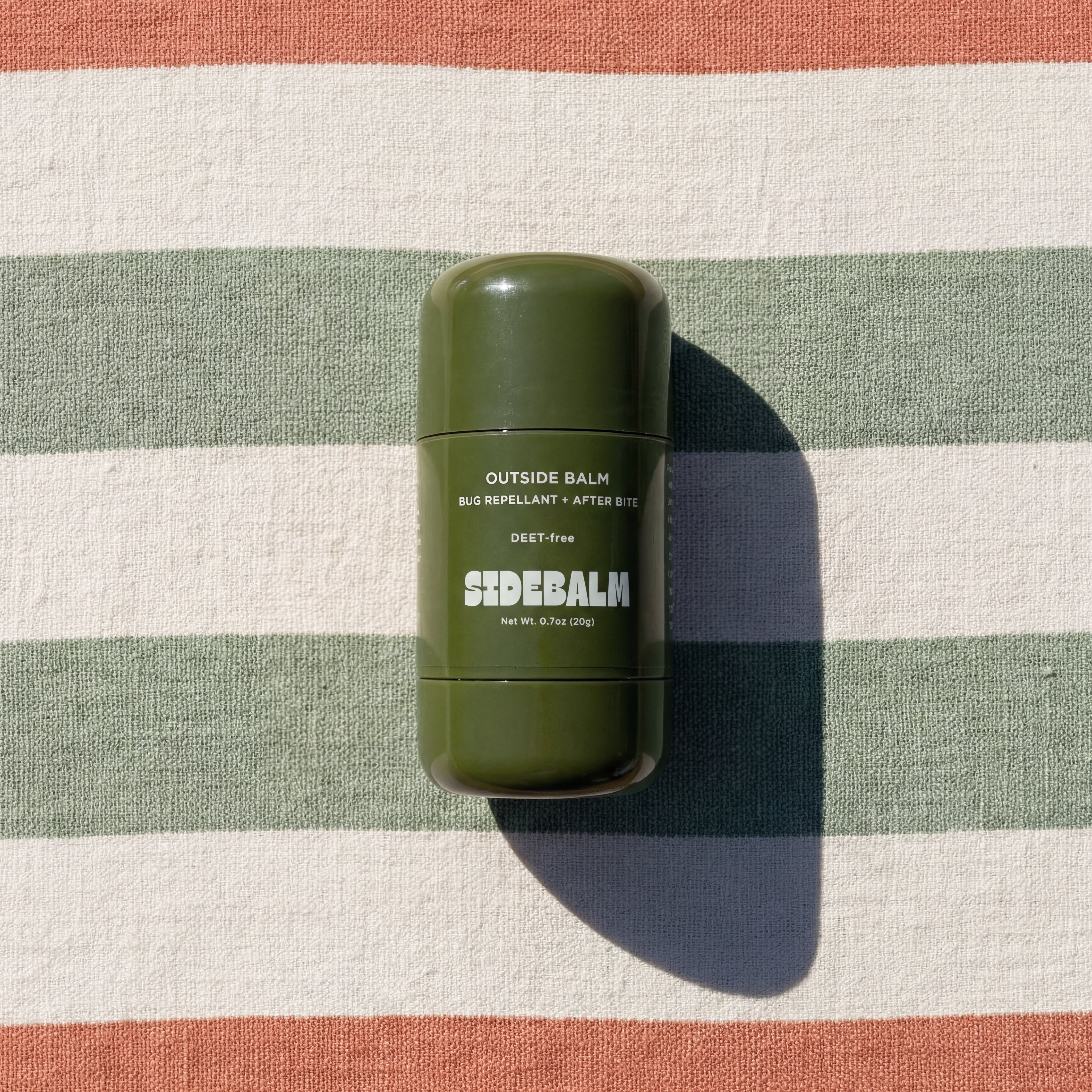
Sidebalm
Outside Balm
Balm · Not EPA-registered; botanical balm with active/inactive ingredient labeling consistent with FIFRA 25(b)-eligible ingredients, but no explicit exemption claim found
Scored June 28, 2026 by our published scoring rules
Retailer links may earn a small commission that helps cover site costs. Scores are never affected.
Our take
Appealing as a lifestyle product and handy as an after-bite soother, this botanical swipe-on balm nonetheless lands a firm not recommended as a repellent, flagged for an undisclosed formula and no proven mosquito protection. With none of the active concentrations published, we can't estimate any protection window, so effectiveness scores close to zero. The evidence is weak, with 4 of 5 audited claims rating weak. Safety is the larger concern, driven by clove oil's high sensitization and irritation risk plus a pregnancy caution. It does earn credit for fully accounting for its inerts, which helps transparency, but a wax-bound balm that hides its doses cannot be verified to keep bugs off.
Protection facts
- Active ingredients
- Clove oil, Geraniol, Peppermint oil, Cedarwood oil, Rosemary oil
- Mosquitoes, bite-free
- not estimated
- Ticks, bite-free
- not estimated
- Overall score
- 28
- Effectiveness (45%)
- 10
- Evidence and honest claims (25%)
- 31
- Safety (15%)
- 60
- Transparency (15%)
- 45
- Claims checked
- 5 (1 well supported, 4 weak or unsupported)
- Other ingredients
- Listed
Outside Balm ingredients
Active ingredients: Clove oil, Geraniol, Peppermint oil, Cedarwood oil, Rosemary oil
Other ingredients: Carnauba wax, Beeswax
Pros
- A simple carnauba-and-beeswax balm that's easy to carry and apply by hand.
Cons
- No concentrations disclosed and no proven protection.
- Clove and geraniol make it one of the more sensitizing options.
Scorecard
Expand any pillar to see exactly why it scored what it did.
Effectiveness45%10Mosquitoes: protection cannot be modeled because the active concentration is undisclosed. Ticks: protection cannot be modeled because the active concentration is undisclosed. Protection times are modeled from the actives, concentration, and format (see methodology). Scored on a saturating curve (each added hour counts less than the last), 65% mosquito / 35% tick, with lower confidence.
Mosquitoes: protection cannot be modeled because the active concentration is undisclosed. Ticks: protection cannot be modeled because the active concentration is undisclosed. Protection times are modeled from the actives, concentration, and format (see methodology). Scored on a saturating curve (each added hour counts less than the last), 65% mosquito / 35% tick, with lower confidence.
Evidence & honest claims25%31Clove oil is well-supported by published evidence, weighted by how close its concentration is to the studied effective dose (base 43). Of 5 marketing claims audited: 1 strong, 0 moderate, 4 weak, 0 unsupported (-12).
Clove oil is well-supported by published evidence, weighted by how close its concentration is to the studied effective dose (base 43). Of 5 marketing claims audited: 1 strong, 0 moderate, 4 weak, 0 unsupported (-12).
Safety15%60From published dermal toxicology (EPA/CIR/IFRA), scaled by each active's concentration against its leave-on limit: high skin-sensitization risk from Clove oil (−18); high irritation risk from Clove oil (−12); caution advised in pregnancy (−6); moderate aquatic toxicity (−4).
From published dermal toxicology (EPA/CIR/IFRA), scaled by each active's concentration against its leave-on limit: high skin-sensitization risk from Clove oil (−18); high irritation risk from Clove oil (−12); caution advised in pregnancy (−6); moderate aquatic toxicity (−4).
Transparency15%45This product publishes an ingredient list (+20); discloses 0% of active concentrations (+0); discloses 0% of all ingredient concentrations (+0); the full formula including inerts is accounted for (+25).
This product publishes an ingredient list (+20); discloses 0% of active concentrations (+0); discloses 0% of all ingredient concentrations (+0); the full formula including inerts is accounted for (+25).
Every pillar is scored from published rules. Read how we score.
How long it protects
Complete protection ends when the first bite gets through; partial protection keeps reducing bites as repellency decays. EPA label times are verified; the rest are modeled from the actives, concentration, and format.
Mosquito estimate basis (low confidence)
No protection time estimated — this product's label doesn't disclose the active ingredient's concentration, and protection depends on both the ingredient and its strength.
Tick estimate basis (low confidence)
No protection time estimated — this product's label doesn't disclose the active ingredient's concentration, and protection depends on both the ingredient and its strength.
Ingredient disclosure
This product publishes an ingredient list (+20); discloses 0% of active concentrations (+0); discloses 0% of all ingredient concentrations (+0); the full formula including inerts is accounted for (+25).
Active ingredient concentrations are not published for this product.
- Clove oilActive
Active repellent · concentration not disclosed
- GeraniolActive
Active repellent · concentration not disclosed
- Peppermint oilActive
Active repellent · concentration not disclosed
- Cedarwood oilActive
Active repellent · concentration not disclosed
- Rosemary oilActive
Active repellent · concentration not disclosed
- Carnauba wax
Inert (balm base) · concentration not disclosed
- Beeswax
Inert (balm base) · concentration not disclosed
Claims audit
What the marketing says, versus what the evidence supports.
“Doubles as after-bite balm: soothes irritation, calms itch”
EfficacyWeakThe after-bite soothing claim rests on an undisclosed wax/essential-oil base with no clinical support beyond retailer listings.
“Fresh, woodsy scent that mosquitoes hate”
EfficacyWeakScent-masking repellency from clove/geraniol/cedarwood has some lab support generally, but product-specific evidence is absent.
“Soothes itching and irritation from bug bites”
OtherWeakNo clinical support cited; based on manufacturer positioning of the wax/essential-oil base.
“Repels bugs before they bite and soothes skin after”
EfficacyWeakEssential-oil balm with undisclosed concentrations; no published efficacy testing and no EPA evaluation. After-bite soothing is anecdotal.
“DEET-free, petroleum-free, and synthetic-free”
Deet FreeStrongCompositional claim consistent with the disclosed botanical ingredient list.
Safe around dogs & cats?
Worst case from this product’s active ingredients. Do not apply this or any human repellent to your pet.
Mainly from Clove oil, Geraniol, Peppermint oil, and others.
Mainly from Clove oil, Geraniol, Peppermint oil, and others.
Not veterinary advice. Full guide to repellents around pets →