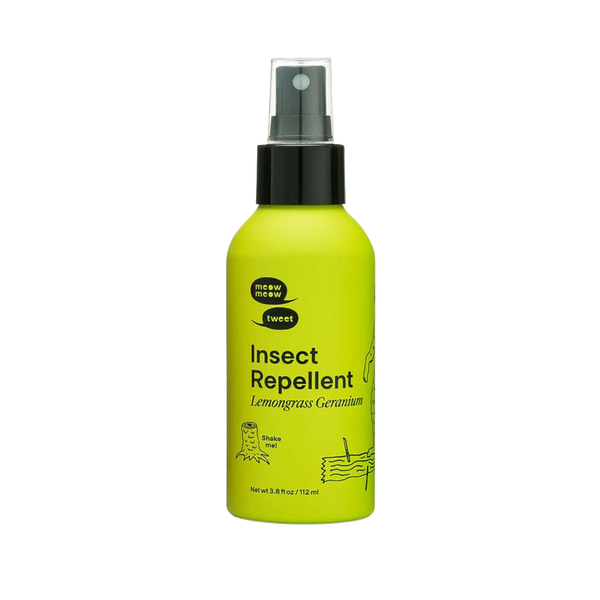
Meow Meow Tweet
Meow Meow Tweet Insect Repellent
Spray · Unregistered botanical repellent; no EPA registration or explicit 25(b) claim stated
Scored June 28, 2026 by our published scoring rules
Retailer links may earn a small commission that helps cover site costs. Scores are never affected.
Our take
A characterful witch-hazel-and-herb mist that, as a repellent, is not recommended, held back by a partly disclosed formula and no proven protection. Because the lemongrass, cedarwood, and geranium concentrations are withheld, we can't estimate any window, so effectiveness scores close to zero. The evidence is thin, dragged down by an audit that turned up 2 weak and 2 unsupported entries against just 2 strong. Safety is the relative bright spot, though lemongrass oil still carries a high sensitization and irritation risk plus a pregnancy caution, and an ethanol-and-vinegar base can feel drying. The brand earns credit for listing every ingredient including inerts, but quantifying none of them leaves transparency middling.
Protection facts
- Active ingredients
- Geranium oil, Lemongrass oil, Cedarwood oil
- Mosquitoes, bite-free
- not estimated
- Ticks, bite-free
- not estimated
- Overall score
- 28
- Effectiveness (45%)
- 10
- Evidence and honest claims (25%)
- 27
- Safety (15%)
- 66
- Transparency (15%)
- 45
- Claims checked
- 6 (2 well supported, 4 weak or unsupported)
- Other ingredients
- Listed
Meow Meow Tweet Insect Repellent ingredients
Active ingredients: Geranium oil, Lemongrass oil, Cedarwood oil
Other ingredients: Fir Needle (Abies siberica) Oil, Witch Hazel (Hamamelis virginiana) Distillate, Lavender (Lavandula angustifolia) Hydrosol, Apple Cider Vinegar (Acetic Acid), Lavender oil, Ethanol
Pros
- A characterful witch-hazel-and-herb spray with a distinctive scent.
Cons
- Concentrations are undisclosed, and there's no proven repellency.
- An ethanol and vinegar base can feel drying and sharp, and lemongrass adds a sensitization risk.
Scorecard
Expand any pillar to see exactly why it scored what it did.
Effectiveness45%10Mosquitoes: protection cannot be modeled because the active concentration is undisclosed. Ticks: protection cannot be modeled because the active concentration is undisclosed. Protection times are modeled from the actives, concentration, and format (see methodology). Scored on a saturating curve (each added hour counts less than the last), 65% mosquito / 35% tick, with lower confidence.
Mosquitoes: protection cannot be modeled because the active concentration is undisclosed. Ticks: protection cannot be modeled because the active concentration is undisclosed. Protection times are modeled from the actives, concentration, and format (see methodology). Scored on a saturating curve (each added hour counts less than the last), 65% mosquito / 35% tick, with lower confidence.
Evidence & honest claims25%27Lemongrass oil is well-supported by published evidence, weighted by how close its concentration is to the studied effective dose (base 43). Of 6 marketing claims audited: 2 strong, 0 moderate, 2 weak, 2 unsupported (-16).
Lemongrass oil is well-supported by published evidence, weighted by how close its concentration is to the studied effective dose (base 43). Of 6 marketing claims audited: 2 strong, 0 moderate, 2 weak, 2 unsupported (-16).
Safety15%66From published dermal toxicology (EPA/CIR/IFRA), scaled by each active's concentration against its leave-on limit: high skin-sensitization risk from Lemongrass oil (−18); moderate irritation risk from Lemongrass oil (−6); caution advised in pregnancy (−6); moderate aquatic toxicity (−4).
From published dermal toxicology (EPA/CIR/IFRA), scaled by each active's concentration against its leave-on limit: high skin-sensitization risk from Lemongrass oil (−18); moderate irritation risk from Lemongrass oil (−6); caution advised in pregnancy (−6); moderate aquatic toxicity (−4).
Transparency15%45This product publishes an ingredient list (+20); discloses 0% of active concentrations (+0); discloses 0% of all ingredient concentrations (+0); the full formula including inerts is accounted for (+25).
This product publishes an ingredient list (+20); discloses 0% of active concentrations (+0); discloses 0% of all ingredient concentrations (+0); the full formula including inerts is accounted for (+25).
Every pillar is scored from published rules. Read how we score.
How long it protects
Complete protection ends when the first bite gets through; partial protection keeps reducing bites as repellency decays. EPA label times are verified; the rest are modeled from the actives, concentration, and format.
Mosquito estimate basis (low confidence)
No protection time estimated — this product's label doesn't disclose the active ingredient's concentration, and protection depends on both the ingredient and its strength.
Tick estimate basis (low confidence)
No protection time estimated — this product's label doesn't disclose the active ingredient's concentration, and protection depends on both the ingredient and its strength.
Ingredient disclosure
This product publishes an ingredient list (+20); discloses 0% of active concentrations (+0); discloses 0% of all ingredient concentrations (+0); the full formula including inerts is accounted for (+25).
Active ingredient concentrations are not published for this product.
- Geranium oilActive
Active repellent (not formally declared) · concentration not disclosed
- Lemongrass oilActive
Active repellent (not formally declared) · concentration not disclosed
- Cedarwood oilActive
Active repellent (not formally declared) · concentration not disclosed
- Fir Needle (Abies siberica) Oil
Other ingredient (not an approved repellent active) · concentration not disclosed
- Witch Hazel (Hamamelis virginiana) Distillate
Carrier / astringent · concentration not disclosed
- Lavender (Lavandula angustifolia) Hydrosol
Carrier / hydrosol · concentration not disclosed
- Apple Cider Vinegar (Acetic Acid)
Carrier / astringent · concentration not disclosed
- Lavender oil
Other ingredient (not an approved repellent active) · concentration not disclosed
- Ethanol
Carrier / solvent · concentration not disclosed
Claims audit
What the marketing says, versus what the evidence supports.
“Lavender oil is marketed in this product but is not an EPA-registered repellent active or on the EPA 25(b) minimum-risk approved active list”
EfficacyUnsupportedReclassified as an inert/fragrance ingredient during data audit; not a recognized repellent active.
“Fir Needle (Abies siberica) Oil is marketed in this product but is not an EPA-registered repellent active or on the EPA 25(b) minimum-risk approved active list”
EfficacyUnsupportedReclassified as an inert/fragrance ingredient during data audit; not a recognized repellent active.
“Safe for children over 2 and dogs”
Kid SafeWeakLemongrass oil (concentration undisclosed) is a high skin-sensitization/irritation risk at this level, so a "gentle / safe-for-kids" claim overstates the safety profile.
“Powerful enough to combat mosquitoes with only plant-based ingredients”
EfficacyWeakNo efficacy testing, concentrations, or protection duration disclosed.
“DEET-free plant-based formula”
Deet FreeStrongAll disclosed ingredients are botanical; no DEET.
“Mostly certified-organic essential oil blend”
NaturalStrongAll listed ingredients except cedar oil are marked certified organic on the label.
Safe around dogs & cats?
Worst case from this product’s active ingredients. Do not apply this or any human repellent to your pet.
Mainly from Geranium oil, Lemongrass oil, Cedarwood oil.
Mainly from Geranium oil, Lemongrass oil, Cedarwood oil.
Not veterinary advice. Full guide to repellents around pets →