Luna Naturals
Luna Naturals Bug & Tick Repellent Spray (Citronella & Cedarwood)
Spray · Not EPA-registered, and it does not need to be: all of its actives are on EPA's 25(b) minimum-risk list, and unlike most botanical brands it does list each active by name with a percentage, which is what the exemption requires
Retailer links may earn us a commission. Scores are never affected.
Pros
- Active ingredient concentrations disclosed
- Plant-based actives from the EPA minimum-risk list
Cons
- Short mosquito protection — reapply about every 0.2–0.3 h
The full review
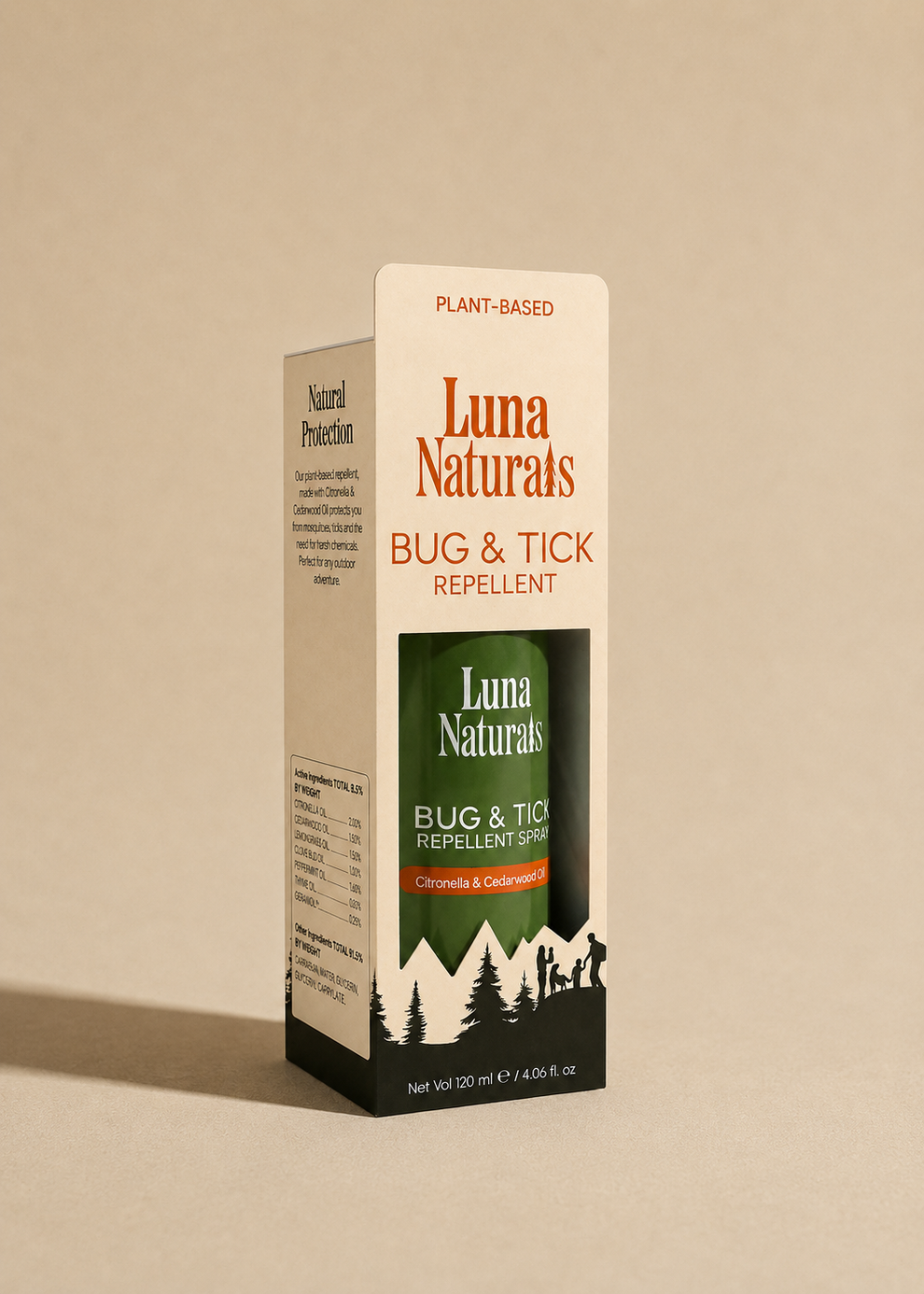
A seven oil botanical pump spray built on citronella with cedarwood, lemongrass, clove bud, peppermint, thyme and geraniol behind it. The formula deserves credit where it is due: every active is named with a percentage on the panel, which is exactly what a plant based repellent sold in the US is supposed to do and more than many botanical brands manage. The oils are real repellents and the blend is a sensible one. Two things complicate it. First, the published panels do not agree with each other. Two retail listings independently show the same figures totalling 15 percent active, while a photograph of the physical carton shows a noticeably lower total, on the order of 8 to 9 percent, and lists geraniol where the retail panels list geranium oil. That gap is close to a factor of two on the number that most determines how long a botanical lasts, so anyone comparing this to another spray is comparing against a figure that depends on which source they happened to read. Second, the surrounding marketing runs well ahead of the substantiation. This is the brand whose own website ships copy with the instruction to the copywriter still in it, telling them to make a coverage claim only if test data exists, and whose product photography is substantially AI generated. Treat this as a competently built botanical spray with a genuine disclosed formula, worth an hour or two between applications, sitting inside a marketing operation that is moving faster than its evidence.
Scorecard
Expand any pillar to see exactly why it scored what it did.
Effectiveness45%20Mosquitoes: 0.2–0.3 h of complete protection. Ticks: 0.1–0.3 h of complete protection. Protection times are modeled from the actives, concentration, and format (see methodology). Scored on a saturating curve (each added hour counts less than the last), 65% mosquito / 35% tick, with reasonable confidence.
Mosquitoes: 0.2–0.3 h of complete protection. Ticks: 0.1–0.3 h of complete protection. Protection times are modeled from the actives, concentration, and format (see methodology). Scored on a saturating curve (each added hour counts less than the last), 65% mosquito / 35% tick, with reasonable confidence.
Evidence & honest claims25%48Citronella oil is well-supported by published evidence, weighted by how close its concentration is to the studied effective dose (base 65). Of 5 marketing claims audited: 1 strong, 1 moderate, 2 weak, 1 unsupported (-17).
Citronella oil is well-supported by published evidence, weighted by how close its concentration is to the studied effective dose (base 65). Of 5 marketing claims audited: 1 strong, 1 moderate, 2 weak, 1 unsupported (-17).
Safety15%60From published dermal toxicology (EPA/CIR/IFRA), scaled by each active's concentration against its leave-on limit: high skin-sensitization risk from Lemongrass oil at 2% (−18); high irritation risk from Clove oil at 1% (−12); caution advised in pregnancy (−6); moderate aquatic toxicity (−4).
From published dermal toxicology (EPA/CIR/IFRA), scaled by each active's concentration against its leave-on limit: high skin-sensitization risk from Lemongrass oil at 2% (−18); high irritation risk from Clove oil at 1% (−12); caution advised in pregnancy (−6); moderate aquatic toxicity (−4).
Transparency15%75This product publishes an ingredient list (+20); discloses 100% of active concentrations (+40); discloses 100% of all ingredient concentrations (+15); inert ingredients are not fully accounted for (0).
This product publishes an ingredient list (+20); discloses 100% of active concentrations (+40); discloses 100% of all ingredient concentrations (+15); inert ingredients are not fully accounted for (0).
Every pillar is scored from published rules. Read how we score.
How long it protects
Complete protection ends when the first bite gets through; partial protection keeps reducing bites as repellency decays. EPA label times are verified; the rest are modeled from the actives, concentration, and format.
Mosquito estimate basis (moderate confidence)
Estimated complete protection time from active ingredient + concentration; the source research used a lotion-style formulation, matching this spray (no format adjustment). Partial protection (reduced but real bite suppression) is modeled to extend to ~0.4 h as repellency decays. No published tick complete-protection-time data for citronella — Fradin 2002 measured mosquitoes only.
Tick estimate basis (low confidence)
Estimated complete protection time from active ingredient + concentration; the source research used a lotion-style formulation, matching this spray (no format adjustment). Partial protection (reduced but real bite suppression) is modeled to extend to ~0.4 h as repellency decays. Thyme has the best-measured tick CPT of the sub-1-hour botanicals: ~55 min at 10% on skin (Luker 2023).
Ingredient disclosure
This product publishes an ingredient list (+20); discloses 100% of active concentrations (+40); discloses 100% of all ingredient concentrations (+15); inert ingredients are not fully accounted for (0).
Only active ingredients are disclosed. The full ingredient list (inerts/carriers) is not published, so this may not be the complete formula.
- Cedarwood oilActive
Active repellent · 1.5%
- Citronella oilActive
Active repellent · 8%
- Clove oilActive
Active repellent · 1%
- Geranium oilActive
Active repellent · 0.5%
- Thyme oilActive
Active repellent · 1%
- Lemongrass oilActive
Active repellent · 2%
- Peppermint oilActive
Active repellent · 1%
Claims audit
What the marketing says, versus what the evidence supports.
“Every active ingredient is listed by name with its percentage”
OtherModerateGenuinely better disclosure than most botanical repellents, which hide the blend behind a proprietary name or the word fragrance, and it is what EPA's minimum-risk exemption actually requires. It falls short of strong only because the published panels contradict each other: two retail listings show actives totalling 15 percent, while a photograph of the carton shows roughly 8 to 9 percent and names geraniol rather than geranium oil. Full disclosure only helps a buyer if the disclosed numbers agree.
“Long-lasting protection against mosquitoes, ticks, and other biting insects”
DurationWeakLong-lasting is doing a lot of work. Citronella at single digit to mid teen percentages is among the shortest lived actives in this category, typically well under two hours and often under one, which is why it needs frequent reapplication rather than a morning application that carries the day. No landing- or bite-count testing is published for this formula. The tick half of the claim is weaker still, since botanical oils are tested against ticks far less often than mosquitoes and the results are less consistent.
“Safe for adults, children, and pets when used as directed”
SafetyWeakThe pets half is the problem. This blend contains peppermint, thyme, clove and citronella oils, and cats metabolise phenols and terpenes poorly, which is why concentrated essential oils are a documented hazard to them rather than a neutral one. A spray applied to human skin around a household cat is a different matter from one applied to the animal, so this is a caution rather than an alarm, but a blanket safe-for-pets line on a seven oil blend overstates what is known.
“DEET-free plant-based formula”
Deet FreeStrongAccurate and checkable against the panel. Every active is a plant-derived oil on EPA's minimum-risk list and there is no DEET or picaridin present. As always, DEET-free describes what is in the bottle rather than how well it works, which is a separate question.
“Product photography shown on the brand's own storefront”
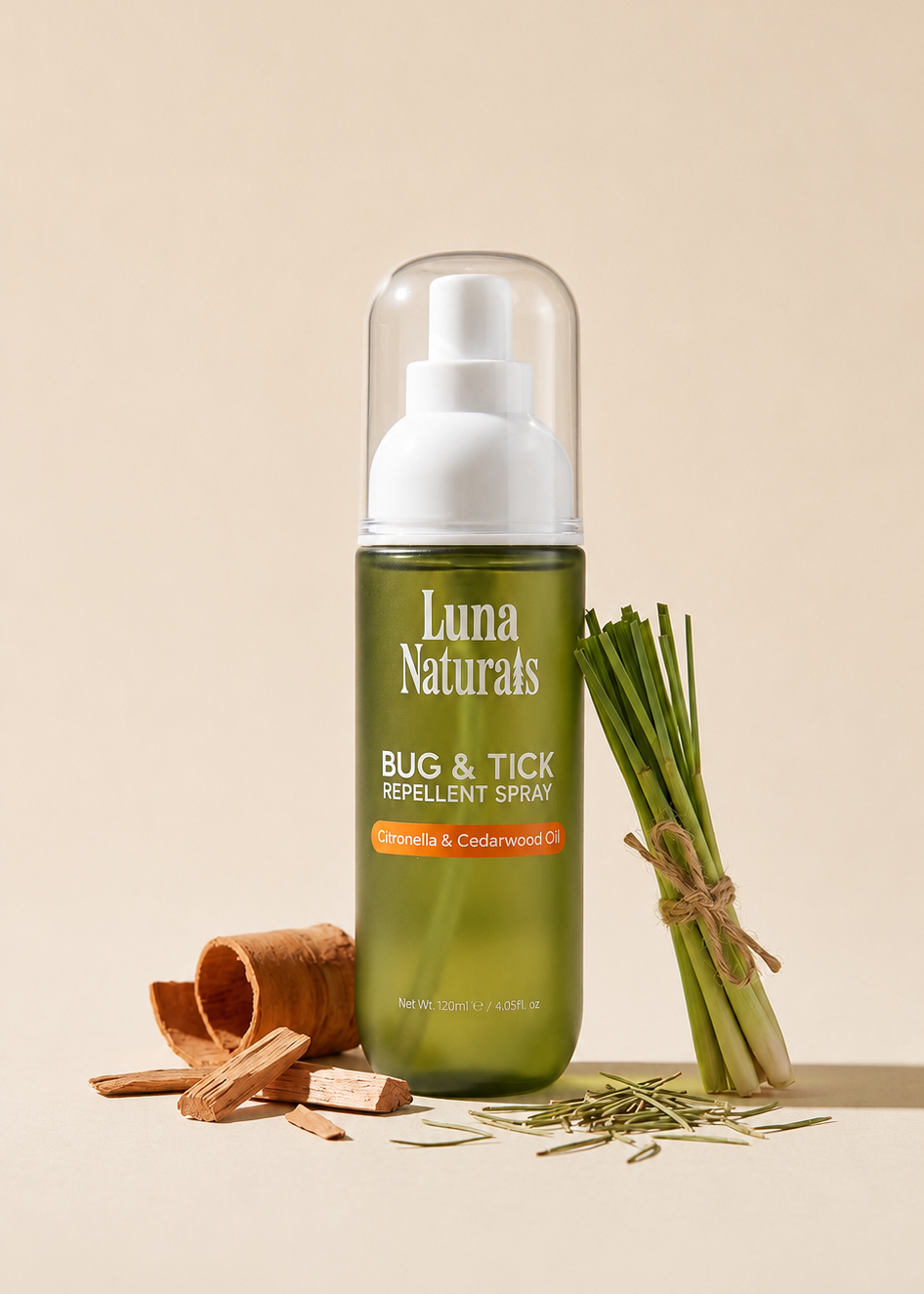
OtherUnsupportedFifteen of the sixty five images across this brand's catalogue are served from its own store under filenames identifying them as AI generations (luna_Gemini3.1Flash_NanoBanana2), spanning eight products including this spray. AI imagery is not itself a defect, and plenty of brands use it for lifestyle shots. It matters here because these are product and packaging renders: one packaging image on the brand's own CDN shows a carton reading Lunata Naturals with a bottle inside it reading Luna Naturals, which is not a photograph of anything that shipped. A shopper looking at a product photo reasonably believes they are seeing the product.
Safe around dogs & cats?
Worst case from this product’s active ingredients. Do not apply this or any human repellent to your pet.
Mainly from Cedarwood oil, Citronella oil, Clove oil, and others.
Mainly from Clove oil, Cedarwood oil, Geranium oil, and others.
Not veterinary advice. Full guide to repellents around pets →
The label
Ingredients, warnings, and directions from the package label. Read it before you buy.