Study summary
Repellent activity of essential oils to the Lone Star tick, Amblyomma americanum
Le Mauff A, Norris EJ, Li AY, Swale DR
Read the original paper- Study type
- Lab
- Year
- 2024
- Species tested
- Amblyomma americanum nymphs
- Published in
- Parasites & Vectors 17:202
- Evidence strength
- Limited evidence
How it was tested
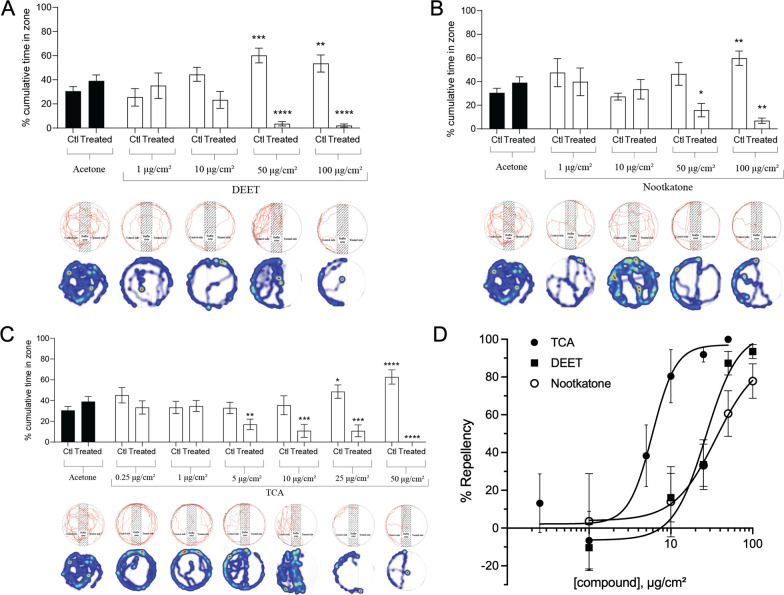
The team compared a contact assay, a spatial (vapor) assay, and a human-fingertip assay, measuring the concentration needed to repel half the ticks and the percentage repelled at a fixed dose.
Summary
A screen of natural and synthetic molecules for repelling lone star tick nymphs, run across three bioassay formats to see how much the test method changes the ranking. Its standout was a synthetic, chrysanthemic acid, far more potent than DEET, alongside a panel of essential oils.
Key findings
The synthetic 1R-trans-chrysanthemic acid was the most potent, needing about a fifth the dose of DEET to repel half the ticks. Among essential oils, clove, geranium, oregano, cedarwood, and thyme led in the contact assay (roughly 82 to 91% repellency at the test dose), while cassia and peppermint were weak. The bigger lesson is that rankings shifted sharply between assay formats, which the authors say makes tick repellents genuinely hard to discover and compare.
Limitations
Potency ranking depended heavily on the assay, the three formats correlated poorly with one another, and no on-skin protection duration was measured.