Study summary
Evaluating repellence properties of catnip essential oil against the mosquito species Aedes aegypti using a Y-tube olfactometer
Batume C, Mulongo IM, Ludlow R, Ssebaale J, Randerson P, Pickett JA, Mukisa IM, Scofield S
Read the original paper- Study type
- Lab
- Year
- 2024
- Species tested
- Aedes aegypti
- Published in
- Scientific Reports 14
- Evidence strength
- Well-supported evidence
How it was tested
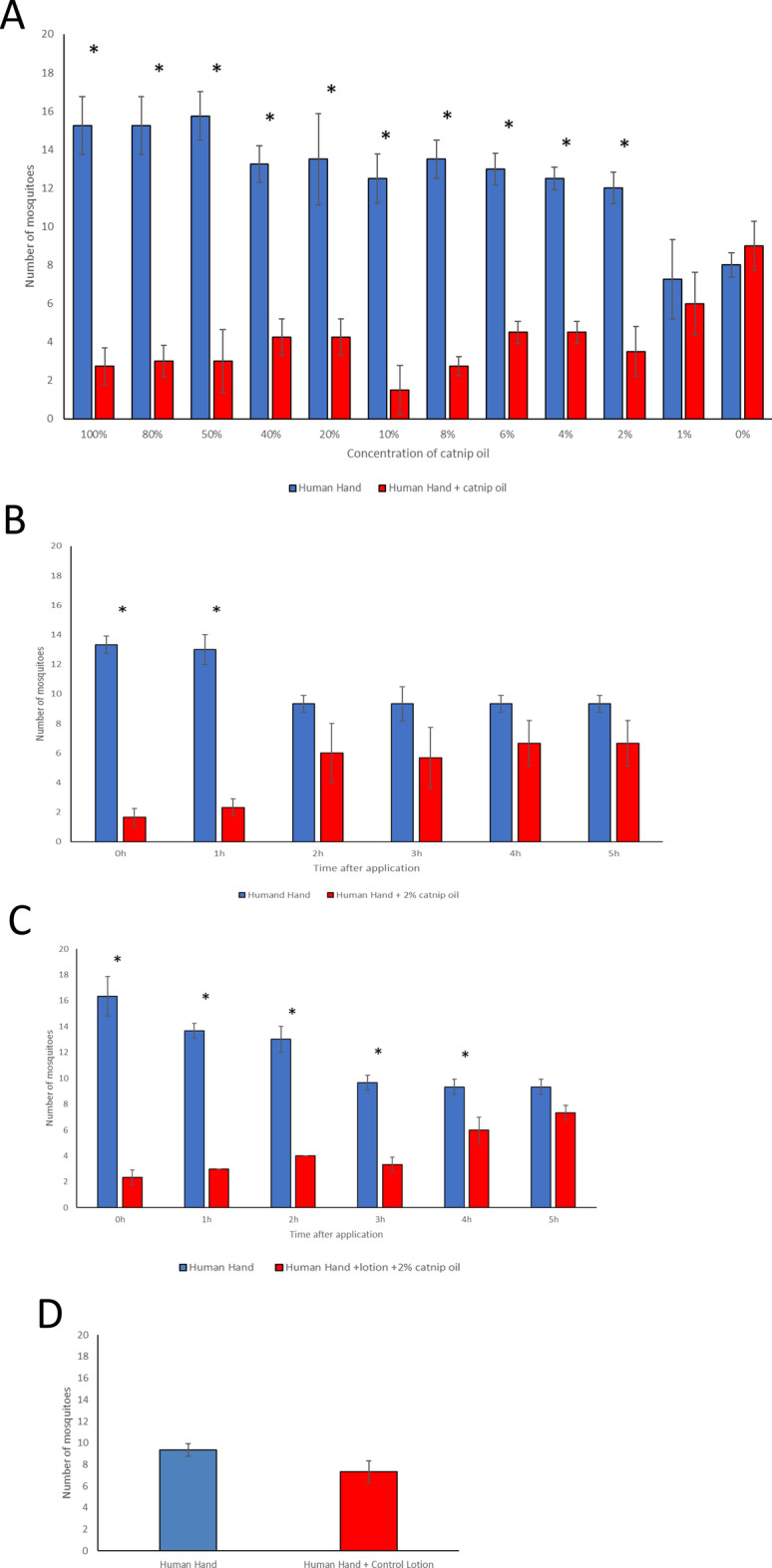
Mosquitoes chose between a treated and an untreated human hand in a Y-tube olfactometer across a range of catnip-oil concentrations, plus a time-course of a 2% formulation in olive oil versus hand lotion.
Summary
A lab test of catnip oil, rich in nepetalactone, as an Aedes aegypti repellent using a Y-tube choice test between a treated and untreated hand. Even a 2% dilution repelled most mosquitoes, and a 2% lotion held up for around four hours.
Key findings
Catnip oil from full strength down to 2% repelled roughly 74 to 90% of responding mosquitoes, while 1% and below did nothing. A 2% oil in hand lotion still repelled significantly at four hours (61% chose the untreated hand), holding up better than the same dose in olive oil, and in this assay it compared favorably with commercial DEET and Odomos products. It is choice-test data, so the numbers reflect the share of mosquitoes diverted, not a skin protection time.
Limitations
A laboratory choice assay rather than an on-skin protection-time test, a single high-nepetalactone chemotype, and short duration next to synthetic repellents.