Study summary
Evaluating repellence properties of a catnip essential oil-based mosquito repellent using the human landing catch method in Eastern Uganda
Batume C, Ssegujja I, Kongai G, Ayebare B, Ludlow RA, Fuchs LK, Logose SM, Ssebaale J, Randerson P, Mukisa IM, Pickett JA, Scofield S
Read the original paper- Study type
- Field Trial
- Year
- 2026
- Species tested
- Culex, Anopheles gambiae (Uganda field)
- Published in
- Scientific Reports 16
- Evidence strength
- Well-supported evidence
How it was tested
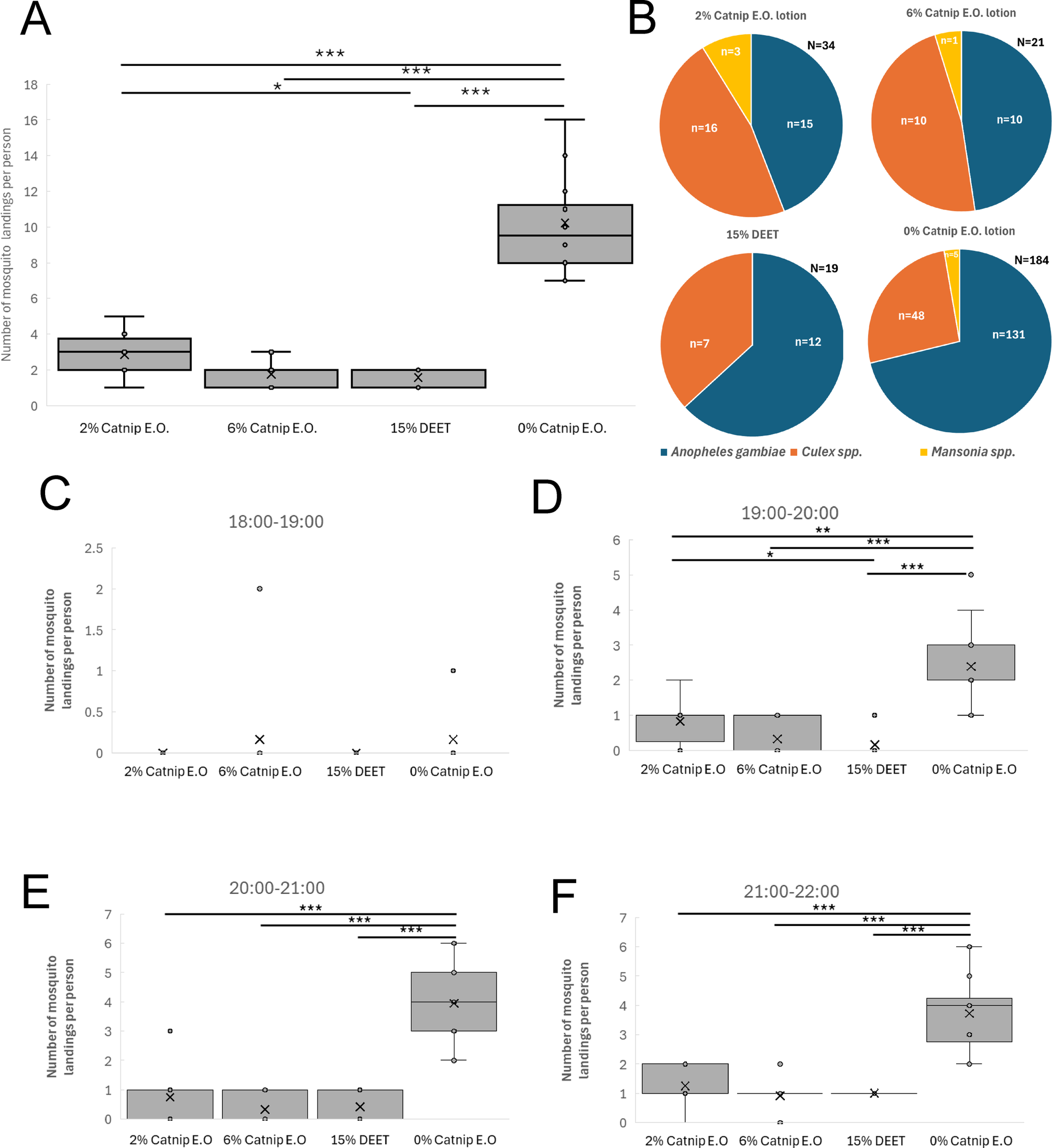
Using the human landing catch method, volunteers sat outdoors over a roughly four-hour evening window with one bare calf treated with one of four preparations, and every mosquito that landed was collected and counted.
Summary
A field test of whether a lotion made from locally grown catnip could repel mosquitoes as well as commercial DEET in rural Eastern Uganda. Catnip oil (over 92% nepetalactone, distilled from plants grown in the Budaka district) was formulated at 2% and 6% and compared against a 15% DEET product and a catnip-free control, with an eye toward an affordable, locally produced alternative in a malaria-endemic area.
Key findings
The stronger catnip lotion matched DEET. Measured as the drop in landings versus the control lotion, 6% catnip and 15% DEET both cut landings about 89%, while 2% catnip reached 79%. Over the evening, control volunteers collected around a dozen mosquitoes each while those wearing 6% catnip or DEET caught only one or two. Most of the biting fauna was Culex, followed by Anopheles gambiae, the main malaria vector. It is a real signal that a well-made catnip lotion can rival DEET over an evening, though this is one short window, not all-day protection.
Limitations
This was a single setting of two villages over one short evening window, so it shows landing reduction across a few hours rather than how long protection lasts. The catnip lotion was a locally produced formulation and DEET was represented by a single 15% product, which limits how far the head-to-head comparison generalizes.